What Is Agentic AI? A Plain Definition and the Guardrails That Make It Usable
Agentic AI is AI that is given a goal and carries out the work itself: it plans steps, takes actions with tools such as files, email or a browser, and checks the outcome before it moves on. Generative AI produces content and stops; agentic AI acts on it. That shift makes the limits around the agent as important as the model itself. Below: a definition without the buzzwords, a test that shows the difference, and the three limits we enforce on every agent we run.
Tested by us on 11 November 2026.
Agentic AI, defined
"Agentic" describes behavior, not a type of model. A system is agentic when a language model decides the next step, takes it with a tool, looks at the result and decides again, until the goal is met or a limit stops it. The program doing that is an AI agent. Agentic AI is that agent together with the tools it can reach, the rules it runs under and the checks on its work. The invoice job below shows all four in one run.
Anthropic draws the line between workflows, where code fixes the path and a model fills in steps, and agents, where the model directs its own process and tool use. Its advice is to start with the simplest version that works and only add autonomy when it pays for itself. That matches what we see: most business automation should stay a workflow, with an agent in the few steps that need judgment.
Agentic AI vs. generative AI, tested on one task
We gave the same job to a model twice: compare six invoices against a bank export, find what's still unpaid and draft reminders for anything overdue. The data had two traps: a partial payment and a payment reference missing its dash.
| As a chat (generative) | As an agent (agentic) | |
|---|---|---|
| What we did | Pasted both files into one message | Gave one instruction in the folder |
| Answer correct? | Yes, both traps caught | Yes, both traps caught |
| Manual steps left for a person | 7: open, copy and paste two files, then save two reminders by hand | 0: two reminder files written, nothing sent |
| Extra judgment | No remark about the export's date range | Flagged that the bank export ended November 5, so a recent payment might be missing |
On this task the reasoning was the same and the difference was who did the hands-on work. On a task that needs live data, the chat couldn't do it at all.
Instruction
One sentence: find which invoices are unpaid or partly paid, draft a reminder for each overdue one in a reminders folder, send nothing, and finish with an overview.
Limits set outside the prompt
Allowed: reading and writing files, listing and creating folders. Everything else, including other shell commands, needs permission it didn't have.
Read and match
It read both files and matched payments to invoices, including the payment whose reference lacked a dash and the customer who paid half.
A gate fires
It tried to create both reminder files with one shell command. The permission settings refused it. Its next attempt used the file-writing tool, which was allowed.
Deliver and stop
Two reminder drafts in the folder, an overview of €3,327.50 open of which €3,025 overdue, and a warning that the bank export ended on November 5. Nothing was sent; a person reviews the drafts.
A second test shows where the gap is bigger than a few clicks. We asked both modes to check which of six links in a document still work. The chat couldn't: without tools it has no way to request a URL, so it said so and handed back a script. The agent ran the requests and reported four working links and two dead ones in 18 seconds. Both tests ran once per mode on November 11, 2026, so treat them as examples rather than a benchmark; the full write-up is in agentic AI vs. generative AI.
Is ChatGPT agentic AI?
A normal chat with ChatGPT or Claude is generative: you ask, it answers, you do the rest. Both now ship agent features that browse, click or edit files for you, and coding agents like Codex and Claude Code are agentic by design. The useful test is how you use it. If you hand it a goal and tools and it chains steps without you prompting each one, it's acting agentically.
The three guardrails we put on every agent
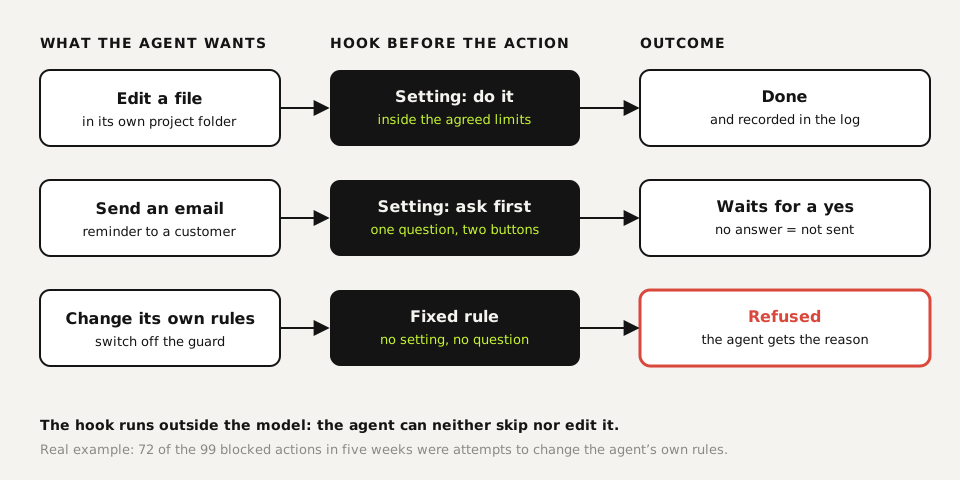
An agent that acts needs limits it can't move itself. Ours live in code, in hooks that run before each action, not in the prompt. A rule in a prompt is a request; a hook is a limit.
Guardrail 1: What the agent may do on its own
Each topic gets one of three settings: do it, do it and tell us, or ask first. Topics include spending money, sending email, posting to social media and shipping to customers. Money has a daily cap. A few things are never allowed under any setting, such as the agent changing its own rules or storing card numbers. Only the owner can change the settings; the agent can't write to that file.
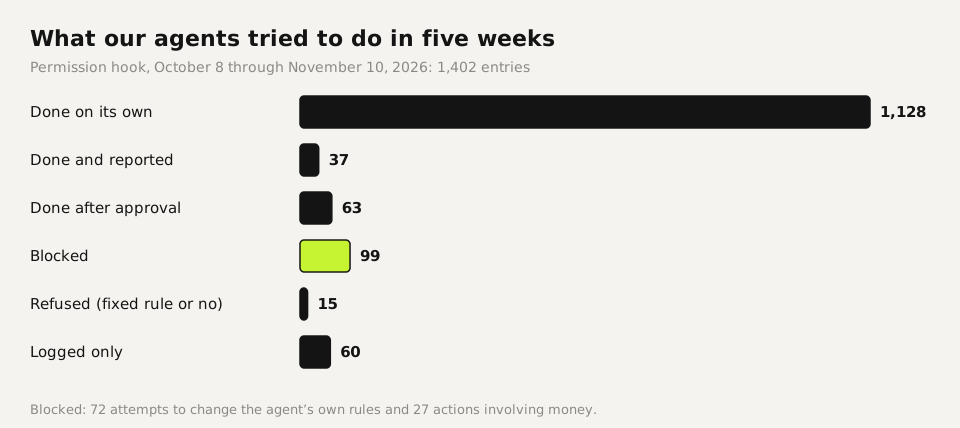
Of the 99 blocked actions, 72 were attempts by an agent to edit its own rules or the guards around it; the other 27 involved money. If those limits had lived only in the prompt, we'd have been relying on the model's restraint 99 times.
Guardrail 2: Where the agent stops
Every job gets a time limit (six hours by default for us) and a memory cap, so a stuck agent ends by itself. When it needs a human decision, it asks one self-contained question with its recommendation and two to four concrete answers to pick from, then waits.
Guardrail 3: Who checks the work
An agent never gets to declare itself done. Code has to pass tests. Writing has to pass a style gate and a second model that scores it. A screen has to pass a fixed twelve-point review. Work that misses the bar goes back. The agent's last act is a report: what's finished, the evidence, and what's still open.
When an agent gets stuck
Long jobs hit walls: usage limits, server restarts, a question waiting on an answer. Of our 1,221 finished jobs since October 4, 2026, 355 needed more than one run. Starting over would mean paying for the same work twice, so we keep each session and resume it.
- Usage limit: the resume is scheduled for when the limit resets, or after 10, 30 or 60 minutes if that time is unknown.
- Waiting on a person: no automatic resume; it continues only with the answer, so it never guesses past a decision it needed.
- Background work still running: it gets a follow-up turn to finish that work, at most four times, after which the job is marked failed and we're notified.
- Broken for real: the job ends as failed with a notice. That happened to 5 of the 1,373 jobs we started; of the rest, 1,221 finished, 137 were stopped by hand and 10 were still running on November 11.
Questions
What is agentic AI in simple terms?
AI that's given a goal and does the work itself: it plans steps, uses tools such as files or email, and checks the result. It's a way of running language models, not a separate kind of model.
What is the difference between agentic AI and generative AI?
Generative AI creates something and stops. Agentic AI also carries out the actions. In our test both gave the same correct answer, but the chat left seven manual steps and the agent left none.
What is an example of agentic AI?
An agent that matches your bank export against your invoices, works out what's overdue and drafts a reminder per customer without sending anything. Coding agents that edit a codebase and run its tests are another everyday example.
What are the risks of agentic AI?
Errors compound across steps, costs rise with every action, and an agent can do something you didn't intend. Put permissions in code, give every job a time limit, and require a check before work counts as done.
What happens when an AI agent gets stuck?
With a time limit it stops on its own. If you keep the session, it can pick up where it left off after a limit or outage. If it's waiting on a person, it should resume only with the answer.
Sources
- Anthropic: Building effective agents checked on
More in aI agents and agentic work
- What Is an AI Agent? How Agents Work, Shown With Our Own JobsAn AI agent takes a goal, picks its own steps, uses tools and checks its work. Explained with data from 1,373 agent jobs we ran ourselves.
- What Is an MCP Server? The Model Context Protocol Explained With One We BuiltAn MCP server lets AI apps like Claude, ChatGPT and VS Code use your tools and data. We built one in 73 lines, connected it and logged what happened.
- Agentic AI vs. AI Agents: What Differs When You Run ThemAn AI agent does one job; agentic AI is the setup that lets agents act on their own, often several at once. Shown with 1,379 jobs from our own work.
- Agentic AI vs. Generative AI: We Ran the Same Tasks Both WaysGenerative AI writes the answer; agentic AI also does the work. We ran two real tasks both ways and counted the steps a person still had to take.
Also useful
- AI automation: when a rule is enough and when you need a modelWhen a fixed rule is enough and when you need AI, based on our test with 50 emails, plus what it costs per 1,000 messages.
- An n8n AI agent that sorts email and drafts replies, with approval before sendingAn n8n AI agent that sorts your inbox and drafts replies, with your approval before anything is sent. Tested on 50 emails, with a review of every draft.
- n8n AI tutorial: build AI steps and agents in n8n, with three tested examplesHow AI works in n8n, with three workflows we built and tested: summarizing email, sorting email and an agent with tools. Results and cost per run included.