Agentic AI vs. AI Agents: What Differs When You Run Them
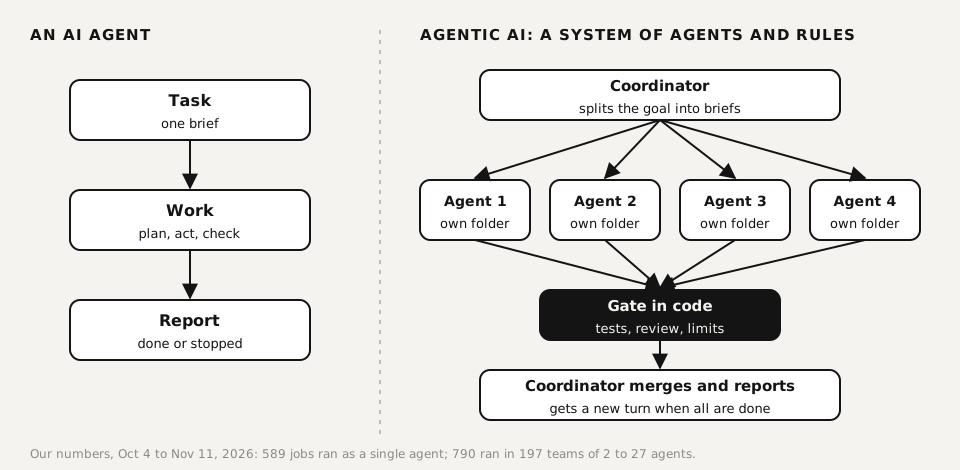
An AI agent is one program working on one task: it plans, acts with tools and checks its result. Agentic AI is the wider setup that lets agents act on their own: the coordination, the rules, the checks and often several agents working toward one goal. If you need one task done, an agent is enough. If work has to be split, handed off and checked without you in the loop, you're building an agentic system. We run both kinds every day, and below we compare how 589 lone agents and 790 team members fared.
Tested by us on 11 November 2026.
The short answer, by situation
- Use a single AI agent when you have one task with a clear finish: fix this bug, sort this inbox, draft these reminders. One agent, one brief, one report.
- Build an agentic system when the goal is bigger than one task and nobody should pass work along by hand. The system splits it, runs the parts in parallel, checks them and merges them.
- The words matter less than the setup. Vendors use both loosely, and some practitioners call the distinction mostly semantic. What matters is whether your setup has a coordinator, rules and checks, not what it's called.
Where the difference shows up
| AI agent | Agentic AI system | |
|---|---|---|
| Unit | One program, one task | Several agents plus the rules around them |
| Who plans | The agent, within its task | A coordinator splits the goal; each agent plans its part |
| Hand-offs | None: it reports to you | Built in: results flow to the coordinator automatically |
| Typical failure | Stops halfway or claims it's done too early | Agents overwrite each other or the merge breaks |
| What you build | A brief, tools and limits | Briefs, a shared contract, folders per agent, a gate, a merge step |
Anthropic's article on building agents makes the same practical point from another angle: start with the simplest setup that works, and only add more autonomy when it pays for itself. In our data, lone agents finished 92.5% of their jobs.
What our own numbers show
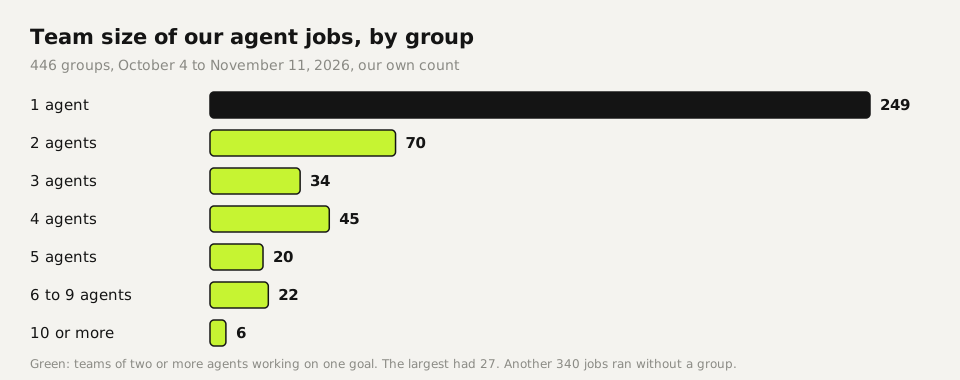
Some definitions first. A job is one agent working on one brief in its own process, with a time limit and a final report. A group is a set of jobs that share a name. A team is a group with two or more jobs. Between October 4 and November 11, 2026 we ran 1,379 jobs. 589 ran alone: 340 without a group and 249 as one-job groups. The other 790 ran in 197 teams; the median team had 3 agents and the largest 27. When the last agent in a group finishes, the coordinating session gets a new turn on its own. Its task for that turn is written in advance: merge the work, run the tests and deliver. 1,027 jobs handed back to a coordinator that way, including some solo jobs started from a conversation.
| Lone agents | Team members | |
|---|---|---|
| Jobs | 589 | 790 |
| Finished with a report | 92.5% | 86.2% |
| Stopped by hand | 6.6% | 12.4% |
| Needed more than one run (finished jobs) | 29.7% | 28.3% |
| Median time, start to report | 54 min | 42 min |
| Median cost per finished job, list prices | $14.19 | $12.82 |
Team members were smaller and quicker per job, which is the point of splitting work. They were also stopped by hand almost twice as often. Our reading: when the plan changes halfway, it affects several agents at once, and we stop the ones whose part no longer fits. That is the real overhead of an agentic setup, more than the cost per job.
What an agentic system needs that a single agent doesn't
These are the rules our agent teams run under.
- A shared contract. The coordinator writes each brief with the same header: the goal, the folder the agent may write to, what it must not do, and what done means.
- One folder per agent. An agent writes only in its own folder. If it wants to change something outside, it hands in a patch with an explanation instead of applying it.
- No side effects from workers. Agents don't publish, restart, send or deploy. The coordinator does that once, after the check.
- A gate before merge. Tests, a review by a separate agent, or a scoring step. Work that fails goes back to the agent that made it.
- A fixed report format. First line is the status, then what exists, the evidence and what's open, so the coordinator can merge without guessing.
Goal: <one sentence>
You write ONLY in: <folder>. Changes elsewhere: as a patch in your folder, with an explanation.
Do not: publish, restart, send email, deploy.
Done = <measurable check>. Final report: result.md, first line "Done." or "Not done: <reason>".
The header we put at the top of every brief in a team.
What we use, and the downside we see
We use single agents for anything that fits in one brief, and teams for large builds and writing batches. The downside shows in the table above: 98 team members stopped by hand against 39 lone agents, in a set of jobs that's only a third larger. Splitting well is the hard part. A shared contract and one folder per agent stop agents from overwriting each other, but they don't help if the goal itself changes. We have no paid relationship with any tool vendor and use no affiliate links.
Questions
What is the difference between AI agents and agentic AI?
An AI agent is one program that plans and acts on a task. Agentic AI is the wider setup that lets agents act on their own: coordination, rules, checks and often several agents toward one goal.
Is agentic AI the same as multi-agent AI?
Not always. A single agent with good rules and checks is already agentic. Multi-agent is the common form once a goal is too big for one brief: 790 of our 1,379 jobs ran in teams.
Do I need agentic AI or a single AI agent?
Start with one agent and a clear brief. Move to a team only when the work splits into parts that can run side by side and you can define how they come back together.
What goes wrong with agentic AI systems?
Agents overwrite each other's files, wait on each other, or deliver parts that don't fit. A shared contract, one folder per agent and a gate before merging prevent most of it.
Sources
- Anthropic: Building effective agents checked on
More in aI agents and agentic work
- What Is Agentic AI? A Plain Definition and the Guardrails That Make It UsableAgentic AI picks its own steps, acts with tools and checks its work. A plain definition, a side-by-side test against a chatbot, and the limits we enforce.
- What Is an AI Agent? How Agents Work, Shown With Our Own JobsAn AI agent takes a goal, picks its own steps, uses tools and checks its work. Explained with data from 1,373 agent jobs we ran ourselves.
- AI Agent Examples: Ten Agents We Run Every Day, With What Each Run CostsTen AI agents that run every day in our own business: what each does, how often, what one run costs and where a person still signs off.
- Agentic AI vs. Generative AI: We Ran the Same Tasks Both WaysGenerative AI writes the answer; agentic AI also does the work. We ran two real tasks both ways and counted the steps a person still had to take.
Also useful
- An n8n AI agent that sorts email and drafts replies, with approval before sendingAn n8n AI agent that sorts your inbox and drafts replies, with your approval before anything is sent. Tested on 50 emails, with a review of every draft.
- n8n AI tutorial: build AI steps and agents in n8n, with three tested examplesHow AI works in n8n, with three workflows we built and tested: summarizing email, sorting email and an agent with tools. Results and cost per run included.
- n8n MCP: expose your workflows to AI apps, and use MCP servers from n8nTurn n8n into an MCP server for Claude, ChatGPT or your own agent, and let n8n use other MCP servers. Tested with MCP Inspector, templates included.