Agentic AI vs. Generative AI: We Ran the Same Tasks Both Ways
Generative AI produces content when you ask: text, images, code. Agentic AI is given a goal and takes the actions itself, using tools and checking results along the way. Pick generative AI when the output is the deliverable and a person handles the rest; pick an agentic setup when the work involves several actions, live data or files. In our tests the answers were often equally good. What changed was who did the clicking, and whether the task could be done at all.
Tested by us on 11 November 2026.
The verdict, by situation
- Use generative AI when the text, image or code itself is what you need, such as a draft email, a summary or a product description, and you're happy to paste it where it goes.
- Use agentic AI when the job involves acting: reading files, checking live systems, writing results somewhere, or repeating a sequence of steps.
- Use neither alone for anything that sends, pays or deletes. Let an agent prepare it and keep a person, or a hard rule in code, on the final step.
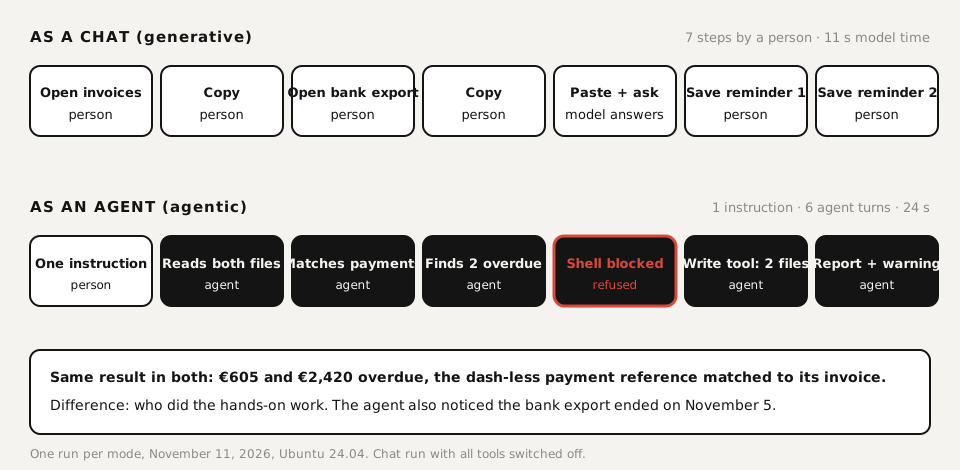
Today's chat assistants blur the line because they can switch tools on. The model underneath is the same kind of model. "Agentic" describes how it's being run: in a loop, with tools and permission to act.
How we tested
We picked two small tasks from ordinary office work and ran each one twice with the same model on November 11, 2026, on Ubuntu 24.04. The generative run used Claude Code in non-interactive mode with every tool switched off, which makes it behave like a plain chat. The agentic run used the same program with a short list of allowed tools. One run per task and mode, so read the timings as an example, not a benchmark.
- Invoices: compare six invoices with a bank export, find what's unpaid or partly paid, and draft reminders for anything overdue. Two traps: one customer paid half, another wrote the invoice number without its dash.
- Links: check which of six links in a document still work. Two of them return a 404.
Results side by side
| Task and mode | Result | Time | Turns | Left for a person |
|---|---|---|---|---|
| Invoices, generative | Correct: €605 and €2,420 overdue, both traps caught | 11 s | 1 | 7 steps: open and copy two files, paste, save two reminders |
| Invoices, agentic | Correct, plus a warning that the bank export stopped on Nov 5 | 24 s | 6 | Review two drafts before sending |
| Links, generative | Declined: no way to check, offered a script instead | 6 s | 1 | Run the script, read the output, fix the links |
| Links, agentic | 4 working, 2 broken (404), one redirect noted | 18 s | 6 | Fix the two links |
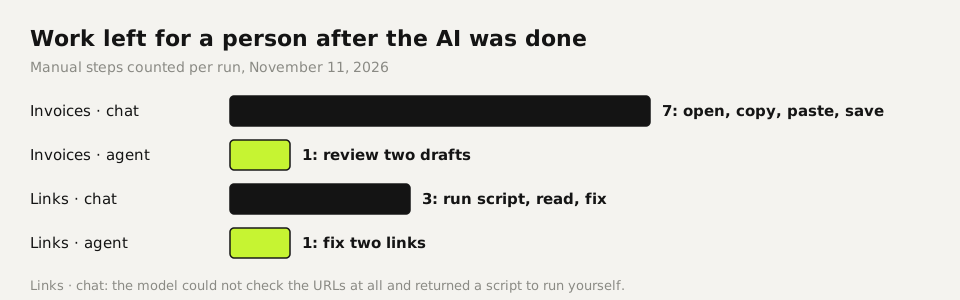
The invoice task shows the usual pattern. Both versions did the reasoning correctly. The chat version stopped where the hands-on work began. The link task shows the harder limit: without tools, a model can't know whether a URL is alive today. The chat version said so and guessed which two looked broken from their paths. It guessed right, but a guess is not a check.
The agent runs also show what supervision looks like. In both tasks it tried a command we hadn't allowed, received a refusal and switched to a permitted route without being told. In the invoice run it wrote the files with the file tool after its shell command was blocked. That is the behavior you want, and it only happens when the limits are set outside the model.
How they compare on what matters
| Generative AI | Agentic AI | |
|---|---|---|
| Output | Content: text, images, code | Completed work: files written, records updated, checks run |
| Who takes the steps | You | The system, within limits you set |
| Speed per answer | Faster: one turn | Slower: several turns, but no manual steps |
| Cost | One model call | Many calls per job; each step costs tokens |
| Main risk | A wrong or made-up answer | A wrong action, like an email that can't be unsent |
| Where your data goes | Only what you paste in | Whatever its tools can read, so scope them tightly |
| Ease for non-programmers | Very easy | Easy to start, harder to set limits well |
Quality. Same model, same reasoning. The agent's edge came from access, not intelligence: it could read the real files and hit the real URLs.
Speed and cost. The chat answered in roughly half the time per task, but a person then had to finish the job. Agent jobs grow with every step. Across 1,221 longer agent jobs we finished since October 4, 2026, the median used $13.44 worth of model time at list API prices, against a few cents for a single chat answer.
Risk and privacy. A chat only sees what you paste. An agent sees what its tools can reach, so give it the narrowest access that works: one folder, read-only where possible, and no sending without a check.
Is ChatGPT generative AI or an agent?
Both, depending on what's switched on. A plain conversation with ChatGPT or Claude is generative AI. Once it browses, runs code or edits files toward a goal you set, it's working agentically. Coding agents such as Codex and Claude Code are agentic by default.
What we use ourselves
We use plain generative output for first drafts and quick answers, and agents for anything with more than one action: research with sources, building and testing code, preparing customer messages. Our agents never get the last word on sending or paying; a rule in code decides that. What annoys us about agents is the cost of long runs and the time it takes to set good limits. We have no paid relationship with any of the vendors mentioned and use no affiliate links.
Questions
What is the difference between agentic AI and generative AI?
Generative AI produces content and stops. Agentic AI pursues a goal by taking actions with tools and checking the results. In our invoice test both gave the same correct answer, but the chat left a person seven manual steps and the agent left a review.
Is agentic AI better than generative AI?
Not by default. It's better when the work involves actions or live data, as in our link check, which the chat couldn't do at all. For a draft or a summary, generative AI is faster and cheaper.
Can generative AI become agentic?
Yes. The same model becomes agentic when it runs in a loop with tools and permission to act. Our tests used one program for both modes and only changed which tools were allowed.
What are examples of agentic AI vs generative AI?
Generative: write a payment reminder. Agentic: find which invoices are overdue by checking the bank export, then draft a reminder for each one and save it. Generative: suggest which links might be outdated. Agentic: request each link and report its status.
What are the risks of AI that acts on its own?
Wrong actions, rising costs and access to more data than needed. Keep permissions narrow, put limits in code rather than the prompt, and keep sending, paying and deleting behind a check.
Sources
More in aI agents and agentic work
- What Is Agentic AI? A Plain Definition and the Guardrails That Make It UsableAgentic AI picks its own steps, acts with tools and checks its work. A plain definition, a side-by-side test against a chatbot, and the limits we enforce.
- What Is an AI Agent? How Agents Work, Shown With Our Own JobsAn AI agent takes a goal, picks its own steps, uses tools and checks its work. Explained with data from 1,373 agent jobs we ran ourselves.
- Agentic AI vs. AI Agents: What Differs When You Run ThemAn AI agent does one job; agentic AI is the setup that lets agents act on their own, often several at once. Shown with 1,379 jobs from our own work.
- AI Agent Examples: Ten Agents We Run Every Day, With What Each Run CostsTen AI agents that run every day in our own business: what each does, how often, what one run costs and where a person still signs off.
Also useful
- An n8n AI agent that sorts email and drafts replies, with approval before sendingAn n8n AI agent that sorts your inbox and drafts replies, with your approval before anything is sent. Tested on 50 emails, with a review of every draft.
- n8n AI tutorial: build AI steps and agents in n8n, with three tested examplesHow AI works in n8n, with three workflows we built and tested: summarizing email, sorting email and an agent with tools. Results and cost per run included.
- n8n MCP: expose your workflows to AI apps, and use MCP servers from n8nTurn n8n into an MCP server for Claude, ChatGPT or your own agent, and let n8n use other MCP servers. Tested with MCP Inspector, templates included.