What Is an AI Agent? How Agents Work, Shown With Our Own Jobs
An AI agent is software that takes a goal, decides on its own which steps get it there, carries those steps out with tools (files, a browser, an inbox, a terminal) and checks the result before it moves on. A chatbot stops at the answer; an agent also does the work that follows. We run agents on jobs that take an hour or more, so this page explains them with our own numbers: how a job runs, what it costs and where it breaks.
Tested by us on 11 November 2026.
AI agents, defined
An AI agent is a language model running in a loop. It looks at the goal, picks a next step, calls a tool, reads what came back and picks again, until the goal is met or it hits a limit. The model is the reasoning part; the tools are its hands; the loop is what makes it an agent.
Anthropic's article Building effective agents describes agents as systems where the model directs its own process and tool use, and contrasts them with workflows, where code fixes the path and a model fills in a step here and there. We use the same split in our own work. The same article makes a point we learned the hard way: an agent needs ground truth from its environment at every step, such as a test result or the output of a command. An agent that only trusts its own reasoning drifts.
How AI agents work: the loop and its parts
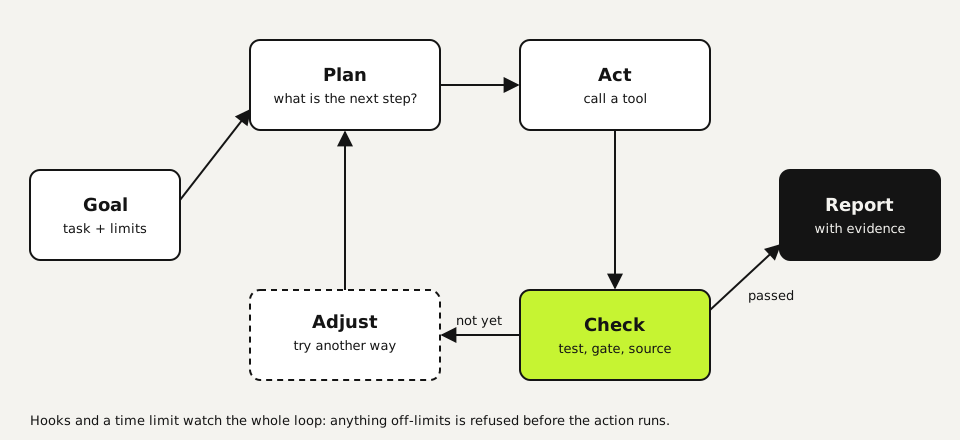
Every agent setup we've built or used has the same five parts:
- A model that reads the situation and decides the next step.
- Tools it can call: read a file, run a command, search the web, send an email, query a database. Many tools now plug in through MCP, an open standard for connecting AI apps to other software.
- Instructions and memory: the task, the rules, and notes it keeps between steps or sessions.
- A check: tests, a validator, a second model that reviews, or a person.
- Limits: what it may never do, how long it may run and how much it may spend.
Most guides spend their time on the model and the tools. In our experience the check and the limits decide whether an agent can keep working while nobody watches: we run eight hook scripts around our agents and only a handful of tool connections.
One agent job, start to finish
Here is a real job from November 2026. An agent was asked to write a batch of explainer pages for a website, including the page you are reading. Nobody watched while it worked.
Read the brief and the boundaries
The task sat in a file: which pages, which folder it could write to, and what was off-limits (publishing, sending, restarting anything). Done meant one thing: every page passes an automated review.
Make its own plan
It read the style guide and the topic briefs and set its own order: evidence before text, and the most-searched topics first. One choice shows how that works in practice. A brief about a coding tool asked for an install plus three test tasks. The install worked, but the tool's login on the test machine had expired, so the three tasks were impossible. The agent uninstalled everything, restored the machine to how it was, and moved that topic to the end of its list instead of writing a page without the tests.
Use tools
It fetched official documentation to check facts, counted jobs in our own logs for the numbers on this page, drew the diagram above and had another machine render it so it could look at the result.
Get checked, then fix
Each page goes through a gate: a script that rejects banned phrases, overlong sentences, broken links and missing sources, then a second model that scores the writing. Below 8 out of 10 the agent rewrites, three rounds at most. On the Dutch version of this page the reviewer flagged a sentence claiming that an hour of agent work costs more than a month's subscription. The numbers didn't support it: the median job came to $13.44, less than one $20 month. The agent removed the claim and resubmitted.
Report progress in plain words
Every 10 to 20 minutes it posted one sentence on where it stood, so we could follow along without reading logs.
Hand in a final report
The last step is a report: what is done, what score each page got and what it skipped and why. When it found no first-hand evidence for a topic, it skipped that page.
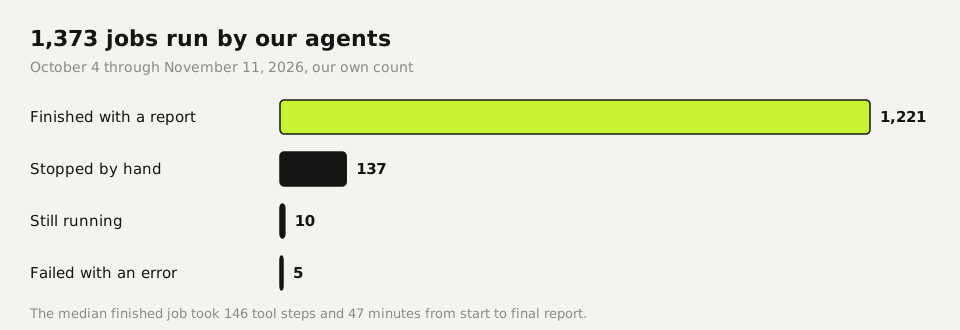
We run every job that outlives a chat this way. Between October 4 and November 11, 2026 that came to 1,373 jobs: 1,221 finished with a report, 137 we stopped by hand, 5 failed and 10 were still running. Half of the finished jobs took 146 tool steps or more. The median time from start to final report was 47 minutes. That clock includes any time a job sat waiting for one of us to answer a question, so the agents' working time is shorter; we don't track it separately.
The five types of intelligent agents in AI
The classic typology comes from Russell and Norvig's textbook, Artificial Intelligence: A Modern Approach. It runs from simple to adaptive:
| Type | How it decides | Everyday example |
|---|---|---|
| Simple reflex agent | Reacts to what it sees right now | A thermostat |
| Model-based reflex agent | Also tracks what it saw before | A robot vacuum that remembers which rooms are done |
| Goal-based agent | Picks actions that move it toward a goal | A route planner |
| Utility-based agent | Weighs which outcome is best, like fast versus cheap | A ride app choosing between routes and prices |
| Learning agent | Improves from its own results | A spam filter that learns from what you mark |
Today's LLM agents are goal-based at heart: you give them a goal and they search for a path. When you're choosing a tool, group them by where they work. Coding agents work inside a codebase (Claude Code, Codex). Browser agents click through websites. Workplace agents live in office software, and custom agents are the ones you build on a platform or with an SDK.
AI agent vs. chatbot vs. automation
| Chatbot | Automation | AI agent | |
|---|---|---|---|
| Who decides the steps | Nobody; it answers once | You, up front | The model, as it goes |
| Acts outside the chat | No | Yes, the same way every time | Yes, whatever the situation needs |
| Example | Explains how to write an invoice | Marks an invoice paid when the payment lands | Goes through October's unpaid invoices, checks payments and drafts reminders |
| Weak spot | Leaves the follow-up work to you | Breaks on exceptions | Less predictable, higher cost |
Use plain automation for work that runs the same way every time. Add an agent only for the steps that need judgment: reading, choosing, writing.
Is ChatGPT an AI agent? The regular chat window is not: it answers and waits for you. It becomes agentic when you switch on features that let it browse, run code or edit files for you, and both OpenAI and Anthropic ship such features. Coding agents such as Codex and Claude Code are full agents. A simple test: if it chains several actions toward your goal without you prompting each one, it's acting as an agent. We use Claude Code, Codex and other coding agents side by side every day.
What AI agents cost
On a subscription you pay a flat monthly fee. Claude Pro is $20 a month and includes Claude Code; Max is $100 and Ultra $200, each with more usage (checked November 11, 2026). The free Claude plan does not include Claude Code. If you build your own agent on an API, you pay per use, and agents use a lot.
Each run reports what it would have cost at the model provider's list API prices; we pay a subscription, so this is list-price value, not our bill. Across our 1,221 finished jobs, a mix of software and website builds, writing, design and admin, the median came to $13.44. A quarter were above $26.55 and the most expensive tenth above $54.68. We didn't split the figures by job type, so treat them as an indication of scale. On a subscription you don't pay per job, but long jobs use up your plan's limit faster. That is why we move every step that runs the same way each time into plain code and keep the model for judgment calls.
What goes wrong with AI agents, and the fixes we use
Anthropic names two costs of autonomy: higher spend and compounding errors, since each step builds on the last. Add the obvious one: an agent can do something you didn't want, like send an email or delete a file. Our fixes:
- Put limits in code, not in the prompt. A rule in the prompt is a request. A hook, a script that runs before every action, is a limit: it refuses what's off-limits no matter what the model concludes.
- Decide per topic how much the agent may do alone. Editing files: go ahead. Sending email: ask first. Spending above a cap: never without a yes. Over five weeks our hook logged 1,402 entries, blocked 99 actions and refused 13 outright.
- Require a hard check before done. A test suite, a validator or a second model. Our writing agents, for instance, only report a page as done once an automated reviewer scores it 8 or higher.
- Give every job a time limit and a final report. The report says what's done, what isn't and what evidence backs it.
Questions
What is an AI agent in simple terms?
A program that gets a goal and works out how to reach it. It takes steps with tools, such as files, a browser or email, and checks after each step whether it's on track.
How do AI agents work?
In a loop: plan a step, call a tool, read the result, check it, and plan again. A model does the reasoning; tools, instructions, checks and limits around it decide how useful and how safe it is.
What are the types of intelligent agents in AI?
The textbook list has five: simple reflex, model-based reflex, goal-based, utility-based and learning agents. In practice people group today's agents by where they work: coding, browser, workplace and custom-built agents.
Is ChatGPT an AI agent?
The chat itself is not. ChatGPT and Claude both offer agent features, and coding agents like Codex and Claude Code are agents in the full sense.
How much does an AI agent cost?
From $20 a month on a subscription such as Claude Pro (checked November 11, 2026). Priced per use, our own median job came to $13.44, with long jobs costing several times that.
Sources
- Anthropic: Building effective agents checked on
- Claude pricing by plan checked on
- Russell & Norvig: Artificial Intelligence, A Modern Approach checked on
- Model Context Protocol: introduction checked on
More in aI agents and agentic work
- AI Agent Examples: Ten Agents We Run Every Day, With What Each Run CostsTen AI agents that run every day in our own business: what each does, how often, what one run costs and where a person still signs off.
- What Is Agentic AI? A Plain Definition and the Guardrails That Make It UsableAgentic AI picks its own steps, acts with tools and checks its work. A plain definition, a side-by-side test against a chatbot, and the limits we enforce.
- Agentic AI vs. AI Agents: What Differs When You Run ThemAn AI agent does one job; agentic AI is the setup that lets agents act on their own, often several at once. Shown with 1,379 jobs from our own work.
- Agentic AI vs. Generative AI: We Ran the Same Tasks Both WaysGenerative AI writes the answer; agentic AI also does the work. We ran two real tasks both ways and counted the steps a person still had to take.
Also useful
- AI automation: when a rule is enough and when you need a modelWhen a fixed rule is enough and when you need AI, based on our test with 50 emails, plus what it costs per 1,000 messages.
- An n8n AI agent that sorts email and drafts replies, with approval before sendingAn n8n AI agent that sorts your inbox and drafts replies, with your approval before anything is sent. Tested on 50 emails, with a review of every draft.
- n8n AI tutorial: build AI steps and agents in n8n, with three tested examplesHow AI works in n8n, with three workflows we built and tested: summarizing email, sorting email and an agent with tools. Results and cost per run included.