AI Agent Examples: Ten Agents We Run Every Day, With What Each Run Costs
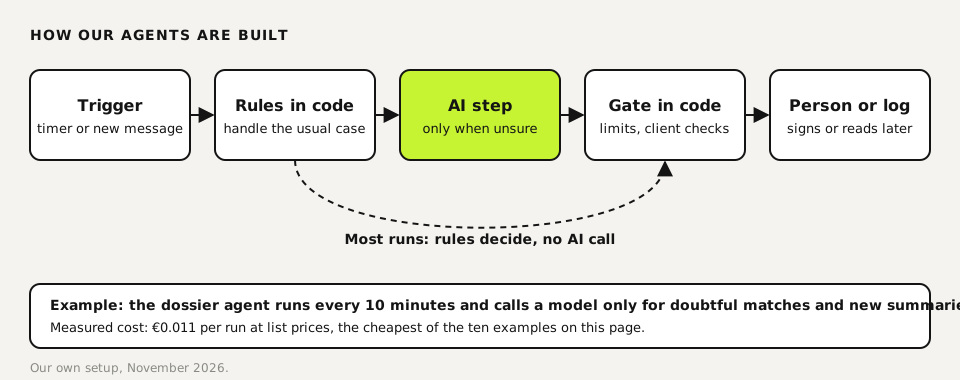
Most lists of AI agent examples name products. This one lists ten agents that run in our own business right now. They range from a skills reviewer that needed a model in 9 of roughly 1,000 checks a week to an inbox watcher that costs €31 a day. For each you get what it does, how often it runs, its cost per AI run and per day, and where a person still decides. The pattern behind all ten is at the top: rules in code do the usual work, and the model only steps in where judgment is needed.
Tested by us on 11 November 2026.
The pattern behind every example
None of these agents is a model left to do whatever it wants. Each one starts from a trigger and lets fixed rules handle the normal case. It calls a model only where those rules are unsure, and it passes a gate in code before anything leaves. That's why most of them cost cents per run, and why some call a model only rarely.
Ten AI agents we run, with cost per run
| Agent | How often | AI runs per week | Per AI run | Per day |
|---|---|---|---|---|
| Dossier keeper | Every 10 minutes | 502 | €0.011 | €0.77 |
| Progress reporter | Every 5 minutes | 2,114 | €0.038 | €11.61 |
| Plain-language rewriter | 3 times a day | 21 | €0.055 | €0.17 |
| Skills reviewer | Every 10 minutes | 9 | €0.089 | €0.11 |
| News writer | Daily | 12 | €0.25 | €0.43 |
| Morning briefing | Daily at 7:30 | 14 | €0.28 | €0.57 |
| Inbox and calendar watcher | Every 15 minutes | 691 | €0.32 | €31.28 |
| Outreach round | Daily | 87 | €0.63 | €7.78 |
| Sales researcher | Twice an hour on weekdays | 92 | €0.88 | €11.61 |
| Security audit | Twice a day | 8 | €1.45 | €1.66 |
- Dossier keeper (every 10 minutes): Files new correspondence and work into the right customer record. Fixed rules do the matching; the model is only asked when a message could belong to two projects, or to summarize something new. Guardrail: AI only where rules are unsure.
- Progress reporter (every 5 minutes): Turns each automation round into one plain-language line on a shared timeline, so nobody has to read logs. Guardrail: Writes to the timeline only; can't change anything.
- Plain-language rewriter (3 times a day): Rewrites technical work notes in an overview into sentences a non-technical owner understands. Guardrail: Rewrites text; touches no systems.
- Skills reviewer (every 10 minutes): Checks new skills that users teach their assistant and flags the ones a person should look at before they spread. Guardrail: Flags only; doesn't publish or delete.
- News writer (daily): Pulls feeds, checks each item against the brand's topics, and writes and publishes short news posts. Guardrail: An automated brand-fit check runs before publishing.
- Morning briefing (daily at 7:30): Collects what happened since the previous evening and what's on today into one overview. Guardrail: Read-only.
- Inbox and calendar watcher (every 15 minutes): Looks through new mail and the calendar and reports what needs attention. Guardrail: Reports; doesn't reply on its own.
- Outreach round (daily): Plans, researches and drafts outreach to potential customers in one agentic round. Guardrail: Every outgoing message passes a client-boundary check.
- Sales researcher (twice an hour on weekdays): Scouts and researches leads and drafts first messages for the sales pipeline. Guardrail: Same gates as every outgoing message.
- Security audit (twice a day): Runs a read-only scan of our own setup, writes a report and posts a summary. Guardrail: Read-only by design.
What the cost numbers tell you
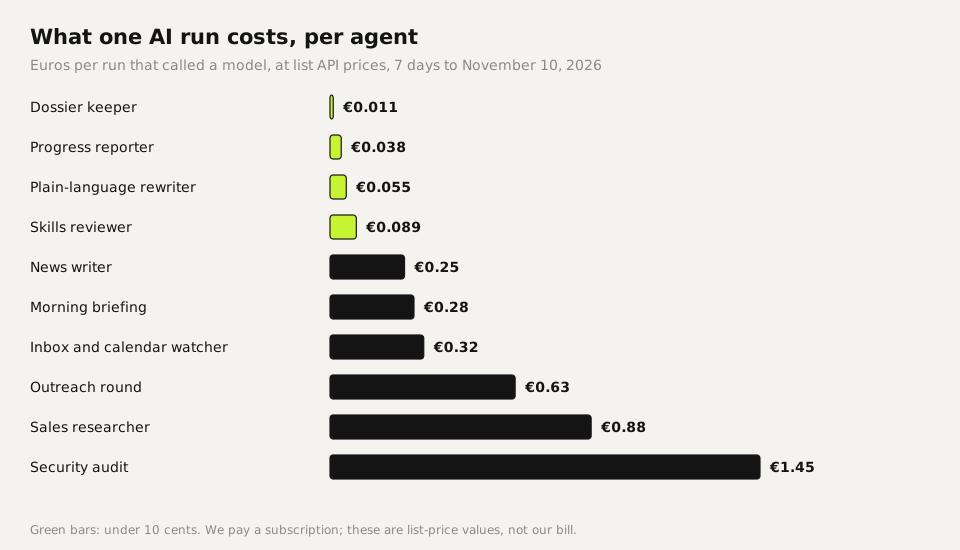
The cheapest agents share one trait: the model does little. The dossier keeper costs about a cent because fixed rules settle almost every match. The expensive ones read and write a lot per run: the sales researcher looks up companies and drafts messages, and the security audit reads through a whole setup. Per run tells you less than per day. The inbox and calendar watcher costs €0.32 a run. It runs every 15 minutes and calls the model each time, so it comes to €31 a day, the most of the ten. The skills reviewer costs nearly three times as much per AI run. Yet it called the model only 9 times in a week, out of roughly 1,000 checks, so it costs €0.11 a day. The dossier keeper sits in between: about half of its runs needed the model.
Longer one-off jobs are a different scale. Since October 4, 2026 we ran 1,373 jobs where an agent works for an hour or more on one task, like building a page or fixing a bug. The median finished job came to $13.44 at list prices. The AI agent explainer shows how one of those jobs runs from brief to report.
Where a person still signs off
Read the last column of the table again. Seven of the ten only read, report or rewrite; nothing they do needs approval. The two that prepare outgoing messages follow a per-topic permission setting: sending email can be set to do it, report it, or ask first. Every message also passes a check that stops one customer's work from reaching another. Only the news writer publishes on its own, and only after an automated brand check.
What goes wrong, and the guardrails it led to
Agents fail in ordinary ways. Of the 1,373 longer jobs, 5 ended in an error and we stopped 137 by hand. On one day two helper agents quit halfway without a word: they had been started in the background of a chat session, and ended when that session did. Since then a hook reminds every agent that long work needs its own process. Our permission hook also blocked 99 agent actions in five weeks. In 72 of them an agent tried to edit its own rules or guards, which only the owner may change. None of those incidents was dramatic, and each one became a rule in code rather than a sentence in a prompt.
What we didn't list, and why
We left out agents that run for clients, because their work isn't ours to describe. We also left out two planning agents whose cost we could only estimate, not measure. And we didn't include product demos: everything above ran in the week before this page was written.
Questions
What are some examples of AI agents?
Ten from our own business, including a dossier keeper, a morning briefing, an inbox and calendar watcher, a sales researcher and a security audit. The table above has all ten. Coding agents such as Codex and Claude Code are other everyday examples.
How much does an AI agent cost to run?
In our measurements, from about one cent to €1.45 per AI run at list prices. Per day it ranged from €0.11 to €31, depending on how often the model is called. Long one-off jobs had a median of $13.44.
Which AI agent example should a small business start with?
One that reads and reports, like a morning briefing or an inbox watcher. It can't do damage, and you see quickly whether its judgment is good enough before you let it act.
Do AI agents work without human oversight?
Most of ours do for reading and reporting. Anything that sends, pays or publishes follows a permission setting or a gate in code, and a person decides wherever the setting says ask first.
Sources
- Anthropic: Building effective agents checked on
- ECB euro reference exchange rates checked on
More in aI agents and agentic work
- What Is an AI Agent? How Agents Work, Shown With Our Own JobsAn AI agent takes a goal, picks its own steps, uses tools and checks its work. Explained with data from 1,373 agent jobs we ran ourselves.
- What Is Agentic AI? A Plain Definition and the Guardrails That Make It UsableAgentic AI picks its own steps, acts with tools and checks its work. A plain definition, a side-by-side test against a chatbot, and the limits we enforce.
- Agentic AI vs. AI Agents: What Differs When You Run ThemAn AI agent does one job; agentic AI is the setup that lets agents act on their own, often several at once. Shown with 1,379 jobs from our own work.
- Agentic AI vs. Generative AI: We Ran the Same Tasks Both WaysGenerative AI writes the answer; agentic AI also does the work. We ran two real tasks both ways and counted the steps a person still had to take.
Also useful
- An n8n AI agent that sorts email and drafts replies, with approval before sendingAn n8n AI agent that sorts your inbox and drafts replies, with your approval before anything is sent. Tested on 50 emails, with a review of every draft.
- n8n AI tutorial: build AI steps and agents in n8n, with three tested examplesHow AI works in n8n, with three workflows we built and tested: summarizing email, sorting email and an agent with tools. Results and cost per run included.
- n8n MCP: expose your workflows to AI apps, and use MCP servers from n8nTurn n8n into an MCP server for Claude, ChatGPT or your own agent, and let n8n use other MCP servers. Tested with MCP Inspector, templates included.