AI Agents for Small Business: Which Tasks to Hand Over, What They Cost per Month, and What to Keep
AI agents for business work best on tasks that are frequent, readable and reversible. Think of summarizing what came in, keeping records up to date and preparing drafts that a person sends. In our own setup those agents cost about €13 to €50 a month each at list prices. An agent that calls the model every 15 minutes runs to €938. Payments above a cap, changes to an agent's own rules and anything a customer receives without a check stay out of reach. Below: the tasks, the monthly numbers and the five things we never hand over.
Tested by us on 10 November 2026.
Start at the bottom of the ladder
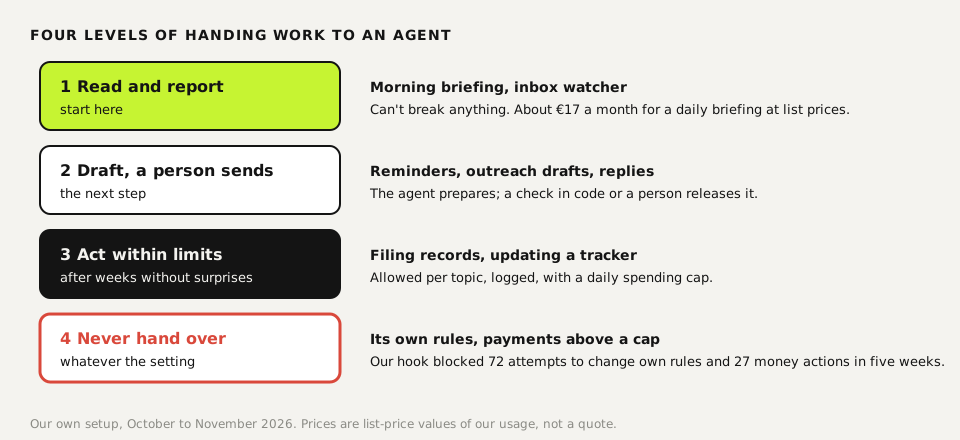
Don't ask which agent to buy; ask how much a task may do without you. We hand work over in four levels. An agent starts by reading and reporting. It moves up to drafting only when its reports are right, and to acting on its own only after weeks without surprises in the log.
Tasks an AI agent handles well, with monthly cost
| Task | Level | Monthly cost in our setup | Who decides |
|---|---|---|---|
| Morning briefing of mail, calendar and the previous evening | Read and report | €17 | You, when you read it |
| Keeping customer records up to date from mail and work | Act within limits | €23 | Nobody, unless the agent flags a doubtful match |
| News or blog posts on your own topics | Act within limits | €13 | An automated brand check before posting |
| Daily check of your own systems for risks | Read and report | €50 | You decide on any fix |
| Drafting outreach to potential customers | Draft, a person sends | €233 | A permission setting and a client check before sending |
| Researching leads before a sales call | Draft, a person sends | €348 | You decide whom to contact |
| Summarizing progress in plain language every 5 minutes | Read and report | €348 | Nobody; the team reads along |
| Watching the inbox every 15 minutes | Read and report | €938 | You decide what to answer |
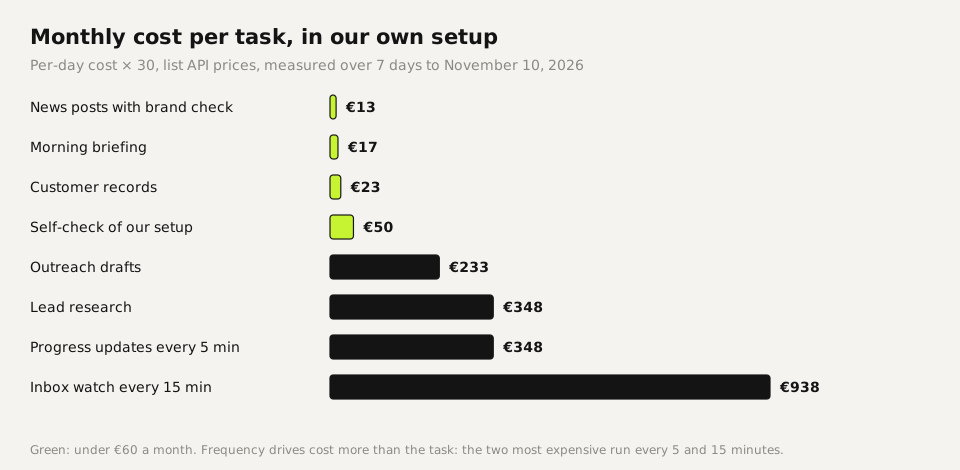
The inbox watcher is the lesson. It checks every 15 minutes and asks the model each time, so it costs 55 times as much as the morning briefing for similar reading work. If you build one, let fixed rules sort the obvious mail first and call the model only for messages the rules can't place. Our customer-records agent works that way and needed the model for about half of its checks.
Five things we never hand to an agent
- Its own rules. An agent may not change its permissions, spending cap or guards. Our hook blocked 72 such attempts in five weeks. Only the owner changes settings, in a file the agent can't write.
- Payments above a cap. Spending has a daily limit; above it the agent asks first and does nothing without a yes. 27 money actions were blocked in the same period.
- Messages to customers without a check. Every outgoing message passes a check that stops one customer's work from reaching another. When in doubt, nothing is sent.
- Decisions about people. Hiring, firing and assessing staff stay with a person. The EU AI Act lists AI used for recruitment and decisions about workers as high-risk (Annex III).
- Legal and contractual commitments. An agent can draft a reply to a contract question; a person signs off on anything that binds the business.
How often agents get it wrong
We don't track errors per task, so we won't invent a rate. What we do count is the outcome of every longer agent job. Of 1,373 jobs since October 4, 2026, 5 ended with an error and 137 were stopped by hand. Where it matters, a check stands between the agent and the result: a writing agent, for instance, only reports a text as finished when a second model scores it at least 8 out of 10.
What it costs a small business to start
You don't need list-price billing to begin. A subscription such as Claude Pro costs $20 a month and Max $100 a month (checked November 11, 2026). Within its limits, the cost per task is then fixed. The table above matters once an agent runs on a schedule all day. Frequent model calls use up a subscription's limit in the same way they raise an API bill.
A first week that doesn't waste money
- Day 1-2: set up one read-and-report agent, such as a morning briefing. Read its output every day and note what it got wrong.
- Day 3-4: write down the rules it should follow, in plain sentences, and put the hard limits (no sending, no paying) in settings rather than in the prompt.
- Day 5-7: let it prepare one kind of draft, such as payment reminders, that you send yourself. Move it up a level only after a week without surprises.
Questions
Which tasks can an AI agent do reliably for a small business?
Frequent, readable and reversible ones: briefings, keeping records up to date, preparing drafts and researching before a call. Anything that sends, pays or commits the business needs a check.
Which tasks should you not give to an AI agent?
Changing its own rules, payments above a cap, unchecked messages to customers, decisions about people and legal commitments. We block the first three in code.
How much does an AI agent cost a small business per month?
On a subscription from $20 a month. In our own setup, scheduled agents ranged from €13 to €938 a month at list prices, mostly depending on how often they call the model.
How do you start small with AI agents?
With one agent that only reads and reports. Watch it for a week, write down its rules, then let it prepare drafts you send yourself.
Sources
- Claude pricing by plan checked on
- EU AI Act (Regulation (EU) 2024/1689), Annex III checked on
- Anthropic: Building effective agents checked on
More in aI agents and agentic work
- AI Agent Examples: Ten Agents We Run Every Day, With What Each Run CostsTen AI agents that run every day in our own business: what each does, how often, what one run costs and where a person still signs off.
- What Is an AI Agent? How Agents Work, Shown With Our Own JobsAn AI agent takes a goal, picks its own steps, uses tools and checks its work. Explained with data from 1,373 agent jobs we ran ourselves.
- AI for small business: Claude for Small Business, ChatGPT, and ten tasks worth handing overWhat Claude for Small Business and ChatGPT cost, ten owner tasks AI handles well, and the one forecast mistake our test caught before it reached the bank.
- What Is Agentic AI? A Plain Definition and the Guardrails That Make It UsableAgentic AI picks its own steps, acts with tools and checks its work. A plain definition, a side-by-side test against a chatbot, and the limits we enforce.
Also useful
- An n8n AI agent that sorts email and drafts replies, with approval before sendingAn n8n AI agent that sorts your inbox and drafts replies, with your approval before anything is sent. Tested on 50 emails, with a review of every draft.
- n8n AI tutorial: build AI steps and agents in n8n, with three tested examplesHow AI works in n8n, with three workflows we built and tested: summarizing email, sorting email and an agent with tools. Results and cost per run included.
- n8n MCP: expose your workflows to AI apps, and use MCP servers from n8nTurn n8n into an MCP server for Claude, ChatGPT or your own agent, and let n8n use other MCP servers. Tested with MCP Inspector, templates included.