Claude marketing skills: a copy check and an SEO check, tested with and without the skill
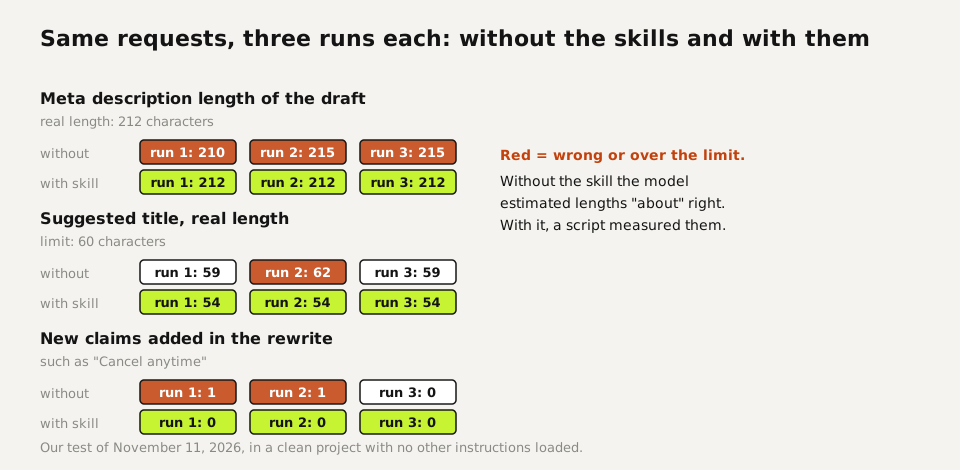
Claude marketing skills are SKILL.md files that teach Claude a fixed way to do one marketing job, such as checking copy or a page's SEO. We wrote two and ran the same requests three times with and three times without them. Without the skills, Claude estimated a meta description at 210 to 215 characters (it was 212). One suggested title came out at 62 characters while labeled "about 58", and two rewrites added "Cancel anytime", which the brief never offered. With the skills, every count was exact and no rewrite added a claim. Both skills are below, ready to copy.
Tested by us on 11 November 2026.
What a marketing skill is, in one paragraph
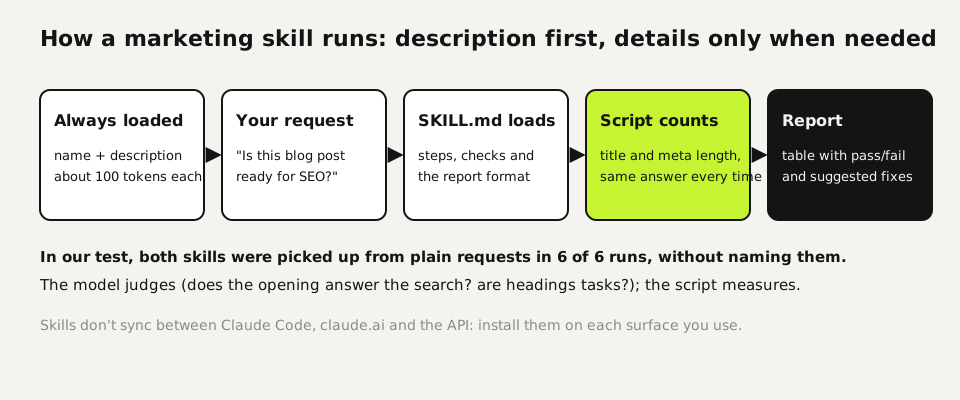
A skill is a folder with a SKILL.md file: a name, a description of when to use it, and the steps Claude follows. Claude always sees the name and description; the steps load only when a request matches. Anthropic's documentation puts that at about 100 tokens per installed skill, so you can keep dozens around. Scripts in the folder run without their code entering the conversation, which is what made the counting reliable in our test. We use around a hundred skills in our own work, from copywriting and SEO audits to code review.
What changed with the skills: our test
We set up two empty projects on November 11, 2026, one with our two skills in .claude/skills/ and one without, and ran Claude Code with Sonnet 5.5 in both. No other instructions were loaded, which we checked by asking the session what it had. The requests were plain: "Can you check this landing page copy before we publish it?" with a short brief, and "Is this blog post ready for SEO?" with a weak draft. We didn't name the skills. Claude picked them up by itself in six of six runs.
| Without skills (3 runs) | With skills (3 runs) | |
|---|---|---|
| Spotted the invented claims in the draft (free trial, 10 hours saved, 5,000 users, paper receipts) | 3 of 3 | 3 of 3 |
| Rewrite added a new claim | 2 of 3 ("Cancel anytime") | 0 of 3 |
| Rewrite kept a banned pattern | 1 of 3 ("Whether you shoot weddings or products") | 0 of 3 |
| Meta description length of the draft (actual length 212) | 210, 215, 215 | 212, 212, 212 |
| Title length of the draft (actual length 73) | 73, 73, 74 | 73, 73, 73 |
| Suggested title within 60 characters | 2 of 3; one was 62 while labeled "about 58" | 3 of 3, measured |
The model without skills was already good at the judgment part: it caught every invented claim in the draft. The skills changed two things. The copy check gave the rewrite a rule (claims not in the brief are cut or asked about), and the rewrite stopped adding new ones. The SEO check moved counting to a script, and the counts stopped being estimates. That's the split we use everywhere: rules and scripts for what never varies, the model for judgment.
Skill 1: copy check
Save this as .claude/skills/copy-check/SKILL.md in your project, or under ~/.claude/skills/ to use it in every project. The description says when to use it in words people type, which is why it triggered without being named.
---
name: copy-check
description: Reviews marketing copy before it is published (landing pages, emails, ads, social posts) and returns a corrected version. Use when someone asks to check, proofread, tighten or approve copy, or says copy "sounds like AI".
---

# Copy check

## Pass 1: facts
1. If a brief or product sheet is given, list every claim in the copy that is not in it: offers, numbers, features, customer quotes.
2. Mark each one KEEP (in the source), CUT (not in the source) or ASK (needs a source from the owner).
3. If no source is given, mark every offer and number ASK.

## Pass 2: words and patterns
Flag and replace filler (really, just, simply, actually, truly), hype (game-changer, unlock, seamless, powerful, leverage, streamline, cutting-edge), throat-clearing ("In today's ... world", "Here's the thing") and patterns ("not just X, but Y", "Whether you're X or Y", rhetorical questions, em dashes, exclamation marks).

## Pass 3: reader
- The first sentence is about the reader's situation.
- Every vague claim becomes the concrete thing.
- Active voice with a named actor.

## Report format
1. Verdict: "Ready", "Ready after the fixes below" or "Not ready: <reason>".
2. Claims table: claim | KEEP/CUT/ASK | why.
3. Flagged lines: original | fix (max 10).
4. Revised copy, with CUT claims removed and ASK claims listed under it.
Shortened slightly for the page; the word lists are the ones we tested with.
Skill 2: SEO page check
This one comes with a small script, because counting characters is exactly the kind of job a model estimates and a script gets right. Save the skill as .claude/skills/seo-page-check/SKILL.md and the script next to it in scripts/measure.py.
---
name: seo-page-check
description: Checks a web page draft against a target keyword before publishing - title and meta description length, keyword placement, whether the opening answers the search, heading structure - and suggests fixes. Use when someone asks if a page or blog post is "ready for SEO", "optimized", or wants a title and meta description.
allowed-tools: Bash(python3 *)
---

# SEO page check

## Step 1: measure with the script, never by eye
Save the draft to a temporary file (title on a line starting with `Title:`, meta on a line starting with `Meta:`), run
`python3 .claude/skills/seo-page-check/scripts/measure.py <file> "<keyword>"`
and delete the file afterwards. Use its numbers; don't recount.

## Step 2: judge what a script can't
- Do the first two sentences answer the search? Quote them.
- Is each H2 a task or an answer, not a label like "Introduction"?
- Is there one concrete example or number a competing page won't have?

## Step 3: report
Table: check | result | pass/fail, for title length (max 60), meta length (110-155), keyword in title, H1 and first 100 words, H2 count, opening answers the search, headings are tasks. Then up to three fixes and a suggested title and meta, measured with the script.
One change after the test: step 1 now writes to a temporary file and deletes it, because of the leftover-file problem above.
import re, sys, json
text = open(sys.argv[1], encoding='utf-8').read(); kw = sys.argv[2].lower()
title = (re.search(r'^Title:\s*(.+)$', text, re.M) or [None, ''])[1].strip()
meta = (re.search(r'^Meta:\s*(.+)$', text, re.M) or [None, ''])[1].strip()
h1 = (re.search(r'^#\s+(.+)$', text, re.M) or [None, ''])[1].strip()
h2 = re.findall(r'^##\s+(.+)$', text, re.M)
body = re.sub(r'^(Title|Meta):.*$|^#+.*$', '', text, flags=re.M)
first100 = ' '.join(body.split()[:100]).lower()
print(json.dumps({'title_chars': len(title), 'meta_chars': len(meta),
  'keyword_in_title': kw in title.lower(), 'keyword_in_h1': kw in h1.lower(),
  'keyword_in_first_100_words': kw in first100, 'h2': h2, 'words': len(body.split())}, indent=1))
scripts/measure.py, the version from our test.
Using the skills in Claude Code, claude.ai and the API
- Claude Code: put the folders in
.claude/skills/(project) or~/.claude/skills/(personal). Edits take effect within the session; a new top-level skills folder needs/reload-skills. - claude.ai: upload each skill as a zip file. Anthropic lists custom skills for Pro, Max, Ultra, Team and Enterprise plans with code execution turned on.
- API: upload through the Skills API; skills there run in a container without network access.
- No sync: a skill installed in one place isn't available in the others. Install it everywhere you want it.
Two rules from the documentation that tripped up our first drafts: the name may only contain lowercase letters, numbers and hyphens, and can't contain the word "claude". The description can be up to 1,024 characters, and it decides when the skill runs, so put the phrases people type in it.
Community marketing skill packs
There are public collections with dozens of marketing skills for CRO, SEO, ads and email. Anthropic's documentation warns to use skills only from sources you trust, because a skill can tell Claude to run code or call tools. Read every file in a downloaded skill before installing it. We take over external skills with their source and license noted, and we keep our own rules in a separate skill, so an update to the external one can't overwrite them.
Your first week
- Install the copy check and run it on the last three pieces you published. Count the claims it marks CUT or ASK.
- Install the SEO check with its script and run it on your five most important pages.
- Add your own banned words and house style to the copy check. Write it in the description if it should also trigger on emails or ads.
Questions
What are Claude marketing skills?
SKILL.md files that give Claude a fixed workflow for a marketing task, such as checking copy or a page's SEO. Claude loads one when a request matches its description.
What is the best Claude skill for SEO?
One that measures with a script instead of letting the model count. In our test, the model alone estimated a 212-character meta description at 210 to 215; with the script it was 212 every time.
Do skills work in the Claude app as well as Claude Code?
Yes, but separately. In claude.ai you upload a skill as a zip file (Pro, Max, Ultra, Team and Enterprise with code execution on); in Claude Code it's a folder. They don't sync.
Do I have to name the skill in my request?
No. In our test both skills triggered from plain requests in six of six runs, because their descriptions contained the words people use.
Are community marketing skills safe to install?
Only after you've read every file. Anthropic advises using skills from trusted sources only, since a skill can direct Claude to run code.
Sources
More in aI by profession
- AI for marketers: five tests, and the quality gate that keeps AI copy out of the slop pile30 AI landing-page drafts, 50 character counts and a review analysis, tested: invented offers were the real risk, and one prompt line removed them.
- AI for accountants: receipts, ledger review and client questions, tested five timesWe ran receipt extraction, a month-end ledger review and the totals five times each. Which steps AI handled, which belong in a formula, and what to check.
- AI for customer service: five support tasks we tested, and how to stop the message pile-upFive support tasks tested, plus ten runs that show when AI invents refund rules and the one prompt line that stopped it. And how to send one message, not five.
- AI for ecommerce: product copy, supplier data, customer questions and stock, each tested three timesWe ran product descriptions, a messy supplier export, customer questions and a reorder check three times each. What AI got right, and what belongs in a formula.
Also useful
- What Are Claude Skills? How They Work, a Tested Example, and When to Use OneClaude Skills explained with a working editing skill we tested 11 times in Claude Code: how often it loaded on its own and how to force it.
- Claude Code Skills: How to Build, Install and Test a SkillBuild a Claude Code skill with a bundled script in ten minutes. We tested when it loads, when it doesn't, and what an unused skill costs in context.
- How to Create Claude Skills That Load at the Right MomentBuild a Claude skill from idea to tested version: description, short core, details in a separate file, and a 10-request trigger test with the fixes it led to.