AI for ecommerce: product copy, supplier data, customer questions and stock, each tested three times
For a small web shop, AI handles four jobs well: product descriptions from a spec sheet, cleaning a messy supplier export, answering customer questions from your product data, and checking which products to reorder. We ran each three times on an invented outdoor shop. It added no product feature that wasn't on the spec sheet in 30 descriptions, converted every weight correctly, and passed unanswerable questions to a person instead of guessing. The reorder check was right every time too, but that's a job for a formula.
Tested by us on 11 November 2026.
What we tested
We invented a shop with five products, a supplier export in three different weight notations with one value missing, a shipping policy and two customer questions that the product data only half answers. We worked out the right answers first. Then we gave Claude (Sonnet 5.5) each task three times on November 11, 2026, every run in a fresh session.
| Task | Runs | Result |
|---|---|---|
| Product descriptions, "use only the spec sheet" | 3 | 15 descriptions, no added features or claims. One run called the 68 g headlamp and the 60 g seat pad "lightweight": a judgment, not a spec. |
| Same task without that instruction | 3 | 15 more, still no added features. One run described IPX4 as "resists splashes", which is what the rating means, and said it avoided "waterproof" on purpose. |
| Clean a supplier export ("0,34kg", "340 g", "520gr", a bare "68", an empty stock field) | 3 | Every weight converted to grams correctly. The bare "68" was flagged as a guess each time, and the empty stock field was left empty, not turned into 0. |
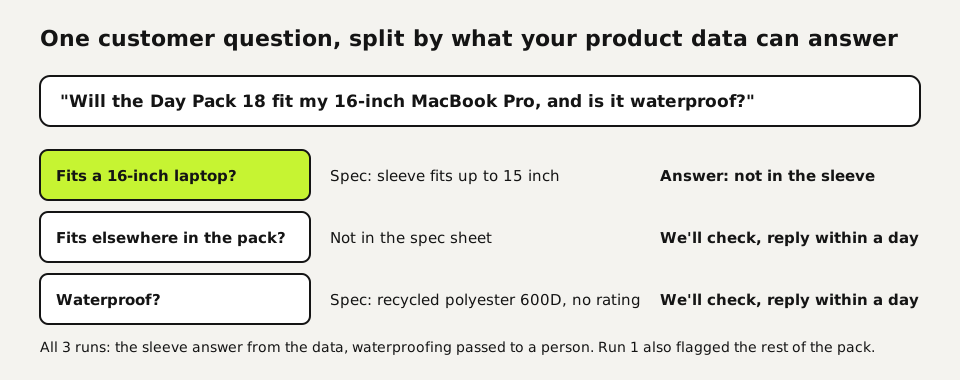
| Two customer questions from product data and shipping policy | 3 | The firm part answered from the data each time; waterproofing, hot-drink retention and dishwasher use passed to a person. Every reply opened with the same cheerful thank-you line with an exclamation mark, which you may want to change to your own tone. |
| Which products need a reorder | 3 | The same three SKUs every run, with the arithmetic shown. |
Two things stood out. The model kept product facts and judgments apart better than we expected: it stated that the bottle keeps drinks cold for 24 hours and refused to stretch that to hot tea. And a blank stock field stayed blank. A cleaning step that turns blanks into zeros would have marked the headlamp as sold out.
Reorders: a formula, not a prompt
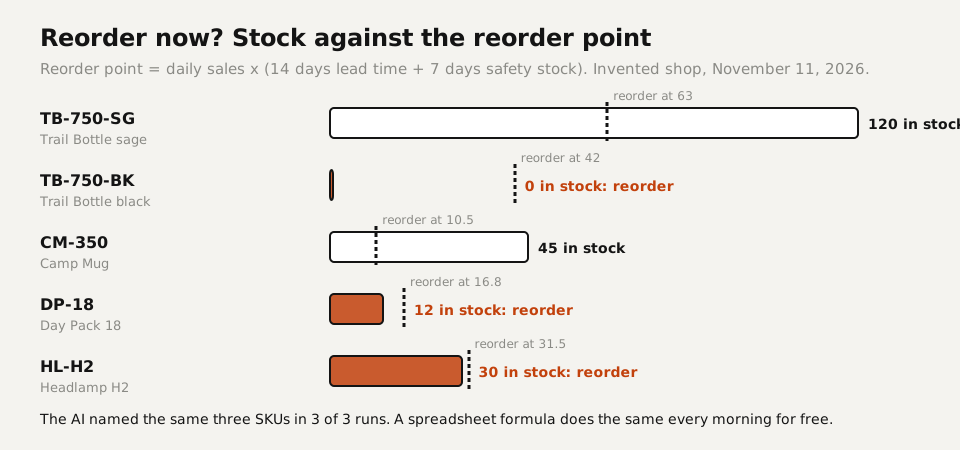
For each step in an automation we ask whether it goes the same way every time. If it does, it becomes a formula or a fixed rule, and AI only gets the steps that need judgment. A reorder point is the clearest case. Daily sales times the days you need to cover is arithmetic, and a spreadsheet does it every morning at no cost per run. AI earns its place on the parts that vary: the product text, the messy export, the customer who asks something your data doesn't cover.
Reorder point (column E): =C2/30*(14+7)
Reorder now (column F):   =IF(B2<E2, "reorder", "")

B = in stock, C = sold last 30 days, 14 = supplier lead time,
7 = safety stock in days
On our test data this marks the same three SKUs as the AI did.
The prompts we used
The customer-question prompt carries the rule that mattered most: what to do when the data runs out. Without it, a helpful model can fill the gap with what products like yours usually do.
Answer this customer question using only the product data and shipping
policy below. If the data doesn't answer something, say we'll check and
get back within one working day; don't guess.

[product data]
[shipping policy]
[customer question]Clean this supplier export into a table with columns: SKU, title
(Title Case), weight in grams (integer), price in EUR (dot as decimal
separator), stock (integer). Flag every value you had to guess.
[paste export]"Flag every value you had to guess" is what kept the empty stock field from becoming a zero.
Ten web shop tasks with what you check
| Task | Give the AI | You check |
|---|---|---|
| Product descriptions (tested) | The spec sheet only | Words like "lightweight" or "durable" that aren't specs |
| Supplier data cleaning (tested) | The export and "flag every guess" | Every flagged value, and blanks that must stay blank |
| Customer questions (tested) | Product data, policies, the "we'll check" rule | Anything about safety, allergies or compatibility |
| Reorder check (tested) | Better: a formula | Lead times when a supplier changes them |
| Category and collection texts (not tested by us) | The products in the category | That it describes what's in stock |
| Translations for another market (not tested by us) | Your text and the target country | Sizes, units and legal wording per country |
| Review replies (not tested by us) | The review and your facts | No promises of refunds you haven't approved |
| Ad copy (not tested by us) | Product facts and character limits | Prices and offers against your shop |
| Return reason analysis (not tested by us) | Return notes without names | Counts against your shop system |
| Email to customers about a delay (not tested by us) | The facts and new date | The date, and that one email goes out, not three |
Customer data and AI tools
None of the tasks above needs a customer's name, address or order history. Product data and policies are yours to paste anywhere. For customer messages, strip names and addresses before pasting into a personal plan. On ChatGPT Free, Plus and Pro, OpenAI's help center lists Improve the model for everyone as on by default; switch it off under Settings → Data controls. OpenAI and Anthropic both state that their business plans exclude training on your content by default (checked November 11, 2026).
Your first week
- Add the reorder formula to your stock sheet and compare its list with what you ordered last month.
- Run your next supplier export through the cleaning prompt and check every flagged value before importing.
- Paste your product data and shipping policy with the customer-question prompt and test it on ten real questions from last month.
Questions
What can AI do for a small web shop?
Write product descriptions from your specs, clean supplier data, answer customer questions from your product data and draft emails. In our three-run tests those came back right; stock checks belong in a formula.
Does AI make up product features?
Not in our test: 30 descriptions, with and without an instruction to stick to the spec sheet, added no features. It did call a 68 g headlamp "lightweight", so read for judgments that sound like specs.
What is an AI agent for ecommerce?
A setup that handles shop tasks on its own, such as answering customer questions or preparing product listings. Give it your data and the rule to pass unknowns to a person, and keep refunds and orders with you.
Can AI answer customer questions about products?
From your product data, yes. In our test it answered what the data covered and passed the rest to a person in three of three runs. Without that rule in the prompt, expect it to fill gaps.
Should AI decide what to reorder?
It got our reorder check right three times, but a formula does the same arithmetic every morning for free. Use AI for the exceptions, such as a supplier email about a changed lead time.
Sources
More in aI by profession
- AI for accountants: receipts, ledger review and client questions, tested five timesWe ran receipt extraction, a month-end ledger review and the totals five times each. Which steps AI handled, which belong in a formula, and what to check.
- AI for small business: Claude for Small Business, ChatGPT, and ten tasks worth handing overWhat Claude for Small Business and ChatGPT cost, ten owner tasks AI handles well, and the one forecast mistake our test caught before it reached the bank.
- AI for customer service: five support tasks we tested, and how to stop the message pile-upFive support tasks tested, plus ten runs that show when AI invents refund rules and the one prompt line that stopped it. And how to send one message, not five.
- AI for HR: what we tested, and why AI shouldn't make your hiring decisionsWe tested AI on job posts, leave-policy questions and ranking two equal candidates. The ranking followed list order ten times out of ten.
Also useful
- AI for marketers: five tests, and the quality gate that keeps AI copy out of the slop pile30 AI landing-page drafts, 50 character counts and a review analysis, tested: invented offers were the real risk, and one prompt line removed them.
- Claude Desktop App: Download, Install and the Settings Worth ChangingWhere to download Claude Desktop for Mac, Windows and Linux, what it costs, what it does that the browser can't, and the settings to change first.
- Claude Sonnet vs Opus: what we found running the same eight tasksWe gave Haiku 5.5, Sonnet 5.5, Opus 5.5 and Fable 5.2 the same eight checkable tasks. Accuracy, cost per task and where each model fits.