AI for marketers: five tests, and the quality gate that keeps AI copy out of the slop pile
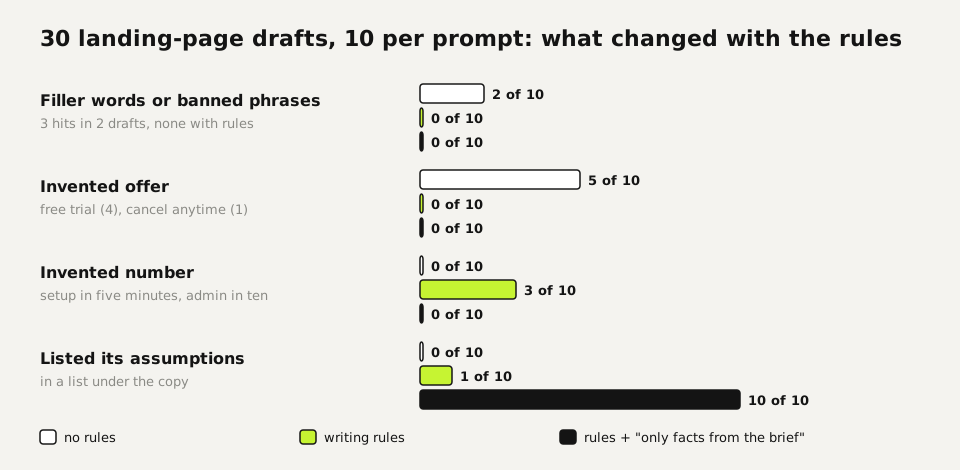
AI writes usable marketing copy, ad headlines and SEO titles in seconds. In our test it reported all 50 character counts correctly, including 30 headlines squeezed between 28 and 30 characters. The real risk was invented facts. Of ten landing-page drafts written without rules, five promised an offer the brief never mentioned, such as a free trial. Writing rules removed the filler words and the invented offers, but three drafts made up a setup time instead. One extra line, "use only facts from the brief, list any assumption", brought that to zero in ten drafts.
Tested by us on 11 November 2026.
Five marketing tasks we ran
We invented a product, TidyBooks, bookkeeping software for freelance photographers at $12 a month, and gave Claude (Sonnet 5.5) five tasks on November 11, 2026. The landing-page task ran 30 times: ten drafts without rules, ten with our writing rules, ten with the rules plus one line about facts. We checked lengths with a script, scanned the copy with the cliché list our own publishing gate uses, and read every draft for claims that weren't in the brief.
| Task | Runs | What we found |
|---|---|---|
| 150-word landing page intro, no writing rules | 10 | Filler words in 2 drafts. 5 drafts invented an offer: a free trial four times, "cancel anytime" once. |
| Same intro, with our writing rules | 10 | No filler words, no invented offers. 3 drafts invented a number instead: setup in two or five minutes, admin in ten. |
| Rules plus "use only facts from the brief, list any assumption" | 10 | No filler words, no invented offers or numbers. All 10 listed their assumptions under the copy. |
| SEO titles and meta descriptions | 1 | All six character counts correct, all within 60 and 155 characters. |
| Ad headlines and descriptions | 3 | 44 counts, all correct. In the hardest run we asked for 15 headlines of 28 to 30 characters: all 15 landed in range, twice. |
| Group 12 customer reviews into themes | 1 | Every review placed, one counted twice and said so (13 placements). It advised against promising Outlook import, because two reviews said it failed. |
| LinkedIn post from survey figures, no rules | 1 | Numbers kept exactly, but two filler adverbs and the "isn't X, it's Y" construction we ban. |
Here is the invented offer next to what the brief said. The brief gave the product, the price ($12 a month) and the audience. It said nothing about a trial. The draft ended with:
Built for freelance photographers who hate bookkeeping. Start your
free trial and let the receipts sort themselves.
Draft 1 without rules. The note under it said the trial was an assumption.
And the opening lines of two drafts, before and after the rules. The first leans on a sentence fragment and a feeling. The second starts with a moment the reader recognizes.
Without rules:
You came into photography for the light, the faces, the moment you
got the shot. Not for chasing receipts at midnight.

With rules:
Your client paid on Friday. The receipt for the rented 85mm lens sits
in your inbox, and the Uber to the venue is in another thread.
Banned-word lists help, but they weren't where most of the risk sat. A model asked for persuasive copy fills gaps with what copy like this usually contains: a free trial, a quick setup, a time saving. The rules stopped one kind of invention and the model switched to another. Only the line that asked for facts from the brief and a list of assumptions stopped both, in all ten drafts.
The quality gate we run on AI copy
Everything we publish goes through three checks in this order, including this page. The first two are cheap and catch most problems. The third catches what a pattern list can't.
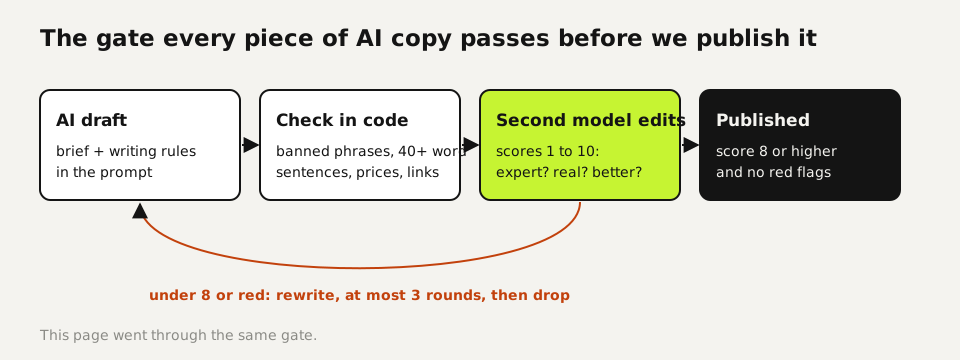
- Writing rules in the prompt. A short list of banned words and constructions, plus the line about facts and assumptions. In our 30-draft test this removed filler words and invented offers.
- A check in code. A short script scans for the same patterns, plus sentences over 40 words. Our own version also checks prices against our price list, email addresses and broken links. Anything red stops the text.
- A second model as editor. It scores the text from 1 to 10 on three questions (below). Under 8 means rewrite, and after three rounds we drop the piece instead of lowering the bar.
For outbound email we add one last question before anything is sent: would the recipient be glad to get this? At least two thirds of the text should be about them, not about us. If the answer is doubtful, we rewrite.
These are the writing rules from our test. Paste them under any copy prompt:
Writing rules:
- No filler words: really, just, simply, actually, truly, literally,
  seamlessly.
- None of these: game-changer, unlock, unleash, supercharge, seamless,
  effortless, powerful, robust, leverage, empower, elevate, streamline,
  revolutionize, cutting-edge, landscape, dive into, delve, journey,
  the power of, at the end of the day, whether you're X or Y,
  not just X but Y.
- No em dashes. No exclamation marks. No rhetorical questions.
- Concrete over vague: name the task, the number, the moment.
- Active voice, named actors. Vary sentence length.
- Use only facts from the brief. List any assumption under the copy.
The last line came out of the test: it took invented offers and numbers from eight drafts in twenty to none in ten. It doesn't stop the model from assuming. It moves every assumption into one list you can check before publishing.
A minimal version of the check in code, in Python. Save your banned patterns one per line in banned.txt, then run it on any draft:
import re, sys
text = open(sys.argv[1], encoding='utf-8').read()
banned = [l.strip() for l in open('banned.txt') if l.strip()]
hits = [b for b in banned if re.search(r'\b' + b + r'\b', text, re.I)]
long = [s for s in re.split(r'(?<=[.!?])\s+', text) if len(s.split()) > 40]
print('banned:', hits or 'none')
print('sentences over 40 words:', len(long))
print('em dashes:', text.count('\u2014'))
sys.exit(1 if hits or long else 0)
Exit code 1 means the draft goes back. Add it as a step in your automation tool before anything is scheduled.
And the editor prompt, close to the one that reviewed this page:
You are a strict editor and subject expert. Score this text from 1 to 10
on three questions:
1. Does it read as written by an experienced professional? Filler,
   cliches and stiff sentences cost points.
2. Does it contain real experience: a test, numbers, pitfalls?
3. Does it answer the reader's question better than what already ranks?
Give one final score and at most five concrete fixes, each quoting the
sentence it is about. Answer only with JSON:
{"score":0,"fixes":["..."]}Ten marketing tasks, with what you check
| Task | Give the AI | You check |
|---|---|---|
| Landing page copy (tested) | The brief, the audience, your writing rules | Every offer, number and promise against the brief |
| SEO titles and descriptions (tested) | The topic, the main keyword, the limits | Length in your CMS, keyword near the front |
| Search ad headlines (tested) | Product facts and the 30/90 character limits | Claims you can't back, such as "free trial" |
| Review and survey analysis (tested) | The raw reviews, numbered | That every review is placed and counts add up |
| Social posts (tested) | Your own figures and the rules | Banned constructions; figures unchanged |
| Content brief for a writer | Keyword, search intent, what the top results miss | That the brief asks for evidence, not word count |
| Email sequence | Who signed up and why | That two thirds of each mail is about the reader |
| Repurposing a long piece | The original and the target format | No new claims added in the shorter version |
| Competitor page summary | Pages you copied in yourself | Quotes against the source, no invented features |
| Campaign report | Exported numbers | Totals against the ad platform, not the summary |
AI marketing agents: what to automate, and where a person signs off
An AI marketing agent is a model that runs steps by itself: researching a topic, drafting, checking and scheduling. We run that kind of chain for this library, and the checks between steps do most of the work. This page is an example. The editor gave the first version a 7 because its test was too small and some numbers didn't match; that is why the landing-page test above has 30 drafts instead of six.
- Automate: research summaries, first drafts, length and cliché checks, scheduling drafts into your tool.
- A person signs off: anything that goes public, anything with a price or an offer, anything that names a customer.
- Never automated: buying ads or raising budgets, replying to complaints in public, and cold outreach to people who never asked to hear from you.
Data you keep out of AI tools
Customer lists, email addresses and CRM exports don't belong in a personal chatbot plan. On ChatGPT Free, Plus and Pro, OpenAI's help center lists Improve the model for everyone as on by default; switch it off under Settings → Data controls. For review analysis like ours, strip names before pasting; the themes don't need them. OpenAI and Anthropic both state that their business plans exclude training on your content by default (checked November 11, 2026).
Your first week
- Paste the writing rules under your next copy prompt and compare the draft with one written without them.
- Add "Use only facts from the brief. List any assumption under the copy" to every prompt, and read that list before anything goes out.
- Pick one recurring task, such as meta descriptions or ad variants, and set up the code check: a length count and a scan for your banned words.
Questions
What are the best AI tools for marketers?
For the writing tasks on this page, a general chatbot such as ChatGPT, Claude or Gemini does the work. What makes the difference is the check after it: writing rules, a scan in code, and a person who verifies every claim.
Can AI write marketing copy that doesn't sound like AI?
Yes, with rules in the prompt. In our test, 2 of 10 drafts without rules had filler words and none of the 20 with rules did. Invented offers were the bigger problem; add "use only facts from the brief, list any assumption" to stop them.
Are AI character counts for ads and SEO reliable?
In our test all 50 counts were correct, including 30 headlines that had to land between 28 and 30 characters. Still check them in your ad platform or CMS, which is where the limit is enforced.
What is an AI marketing agent?
A model that runs several marketing steps on its own, such as research, drafting and checking. Let it draft and check; let a person approve anything that goes public or spends money.
Is it safe to paste customer data into ChatGPT?
Not on a personal plan with training on. Strip names and emails, switch off model training, and use a business plan for regular work with customer data.
Sources
- Google Ads Help: About responsive search ads (up to 15 headlines and 4 descriptions) checked on
- Google Ads Help: About text ads (30-character headlines, 90-character descriptions) checked on
- OpenAI Help Center: Data controls in ChatGPT checked on
- OpenAI: Enterprise privacy checked on
- Claude pricing: Team plan, no model training on your content by default checked on
More in aI by profession
- AI for accountants: receipts, ledger review and client questions, tested five timesWe ran receipt extraction, a month-end ledger review and the totals five times each. Which steps AI handled, which belong in a formula, and what to check.
- AI for customer service: five support tasks we tested, and how to stop the message pile-upFive support tasks tested, plus ten runs that show when AI invents refund rules and the one prompt line that stopped it. And how to send one message, not five.
- AI for ecommerce: product copy, supplier data, customer questions and stock, each tested three timesWe ran product descriptions, a messy supplier export, customer questions and a reorder check three times each. What AI got right, and what belongs in a formula.
- AI for HR: what we tested, and why AI shouldn't make your hiring decisionsWe tested AI on job posts, leave-policy questions and ranking two equal candidates. The ranking followed list order ten times out of ten.
Also useful
- Claude marketing skills: a copy check and an SEO check, tested with and without the skillTwo Claude marketing skills, a copy check and an SEO page check, tested with and without the skill. The SKILL.md files are on this page.
- AI for small business: Claude for Small Business, ChatGPT, and ten tasks worth handing overWhat Claude for Small Business and ChatGPT cost, ten owner tasks AI handles well, and the one forecast mistake our test caught before it reached the bank.
- Claude Desktop App: Download, Install and the Settings Worth ChangingWhere to download Claude Desktop for Mac, Windows and Linux, what it costs, what it does that the browser can't, and the settings to change first.