AI for real estate agents: listings, comps and showing schedules, each tested three times
Left alone, AI copies an agent's shorthand into the ad. In our test, listings from notes saying "great for a young family" or "perfect for retirees, no kids running around" kept that framing in five of six runs. One line in the prompt took every reference to who should live there out of six of six new runs. The arithmetic on comps was right every time. Asked to adjust comps, though, the model made up its own adjustment rates and turned them into a confident value range. It's a small test, two listings and one model, so treat the counts as a warning, not a rate.
Tested by us on 11 November 2026.
Listing descriptions and fair housing
We wrote two sets of listing notes the way agents often jot them down. A family home: "great for a young family, safe neighborhood, walking distance to St. Mary's church and Lincoln Elementary". A condo: "perfect for retirees or empty nesters, no kids running around, walking distance to Temple Beth El and the senior center". We asked Claude (Sonnet 5.5) for a description of each three times on November 11, 2026. Then we ran each three more times with one extra line in the prompt, every run in a fresh session.
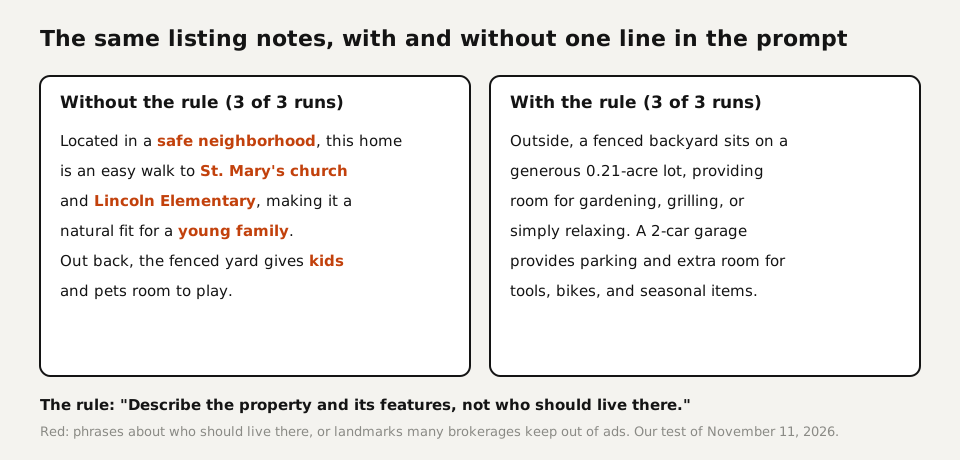
Without the line, five of six listings carried the notes' framing into the ad: "a natural fit for a young family", "ideal for retirees", "no kids". The Fair Housing Act forbids ads for the sale of a dwelling that indicate a preference based on familial status, religion and other protected grounds (42 U.S.C. 3604(c)). "Young family" and "no kids" are familial-status signals. A named church or temple, a school and "safe neighborhood" aren't named in the statute; we treat them as risk calls and leave them out.
Follow the US Fair Housing Act in advertising: describe the property
and its features, not who should live there. No references to
familial status, religion, race, national origin, sex, disability or
age, and no 'safe neighborhood' claims.
The line we added. With it, all three listings kept to the house, and each listed what it left out and why.
This is a checklist, not legal advice. Your broker and your MLS have their own advertising rules; put those in the prompt too.
Comps and showing routes
| Task | Runs | Result |
|---|---|---|
| Family home listing from notes | 3 | "Safe neighborhood", the church and the school in 3 of 3; "young family" in 2 of 3 |
| Condo listing from notes | 3 | "Retirees", "no kids" and the temple in 2 of 3; one run left them out on its own |
| Both listings with the fair housing line | 6 | No reference to who should live there in 6 of 6; each run listed what it dropped |
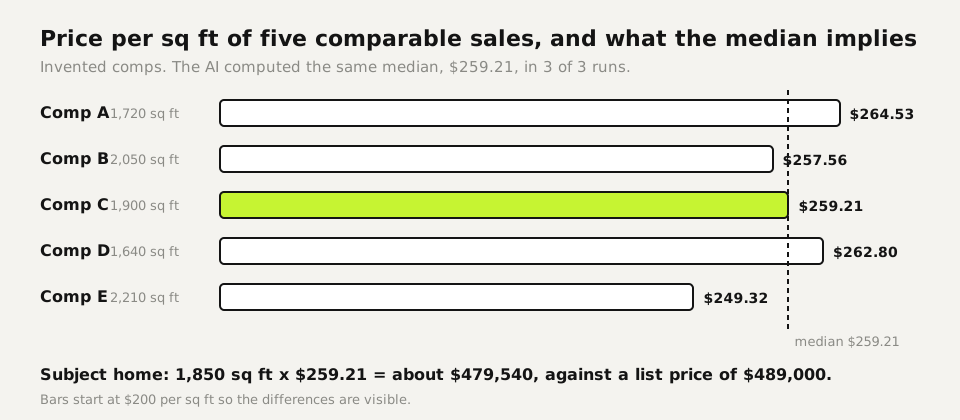
| Price per sq ft for five comps, median, implied value | 3 | $259.21 median and about $479,540 for the subject: right in 3 of 3 |
| Adjust three comps for size, date, roof and kitchen | 3 | Every run invented its own rates, such as $100 per sq ft and a roof worth $8,000 or $10,000. It said so, and still gave a range of about $487,000 to $497,000 |
| Six showings in four hours with fixed windows | 3 | Said in 3 of 3 that it can't be done: the shortest route needs 65 minutes of driving, the window leaves 60 |
The showing test was not designed as a trap. We checked every order of the six homes afterwards with a short script and found none that fits. That is what the model said in each run, with the arithmetic. It refused to produce a schedule that broke a constraint. That is the answer you want before you promise a buyer six homes in one morning.
The adjustment test is the one to remember. With no market data, the model picked adjustment rates itself. They differed between runs: a new roof was worth $10,000 in one and $8,000 in the others. It labeled them as assumptions. But the result read like an appraisal, with point estimates of $493,000 to $495,000, about $14,000 above what the plain per-square-foot median suggested. Every dollar of that difference came from numbers it had made up. Adjustment rates come from your market data or an appraiser; once you have them, AI can do the grid.
Three tasks for agents, with what you check
| Task | Give the AI | You check |
|---|---|---|
| Listing description (tested) | The facts, the fair housing line, your MLS rules | Who-should-live-here phrases; every fact against the listing sheet |
| Comps math (tested) | Sale prices, square footage, and your own adjustment rates | Any rate the model supplies itself |
| Showing schedule (tested) | Homes, windows, driving times | Driving times from your map app, not estimates |
We haven't tested follow-ups after showings, seller updates, social posts or contract summaries. The same two rules apply to all of them: give the facts, and tell the model what it may not add.
Client data and AI tools
Listings and comps don't need a client's name, phone number or finances. Follow-ups and CRM work do, and those belong on a business plan, not a personal one. On ChatGPT Free, Plus and Pro, OpenAI's help center lists Improve the model for everyone as on by default; switch it off under Settings → Data controls. OpenAI and Anthropic both state that their business plans exclude training on your content by default (checked November 11, 2026).
Your first week
- Add the fair housing line, plus your MLS rules, to every listing prompt, and reread your last three listings for who-should-live-here phrases.
- Run your next comps through AI for the arithmetic and compare with your own spreadsheet.
- Before your next showing day, paste the homes, windows and real driving times and ask whether the plan fits.
Questions
Can I use ChatGPT or Claude to write listing descriptions?
Yes, with a fair housing line in the prompt. In our test, five of six listings without it kept phrases like "young family" or "no kids" from the notes; with it, none of six did.
Is AI good at comps?
At the arithmetic, yes: right in three of three runs. At adjustments, no: without market data it made up its own rates and produced a value range that looked like an appraisal.
What is an AI agent for real estate?
Software that runs tasks on its own, such as drafting a follow-up after each showing. We tested single prompts, not agents. Whatever runs on its own, keep anything that goes to a client, and anything about price, with you.
Can AI plan a day of showings?
In our test it worked out that six showings with our constraints couldn't fit in four hours. It said so three times out of three instead of forcing a schedule. Give it real driving times from your map app.
Does fair housing law apply to AI-written ads?
Yes. The law covers the ad you publish, whoever or whatever wrote it. Put the rule in the prompt and read the result before it goes on the MLS.
Sources
- 42 U.S. Code 3604 (Fair Housing Act), paragraph (c): discriminatory advertising checked on
- HUD: Fair Housing Act overview (protected characteristics) checked on
- OpenAI Help Center: Data controls in ChatGPT checked on
- OpenAI: Enterprise privacy checked on
- Claude pricing: Team plan, no model training on your content by default checked on
More in aI by profession
- AI for accountants: receipts, ledger review and client questions, tested five timesWe ran receipt extraction, a month-end ledger review and the totals five times each. Which steps AI handled, which belong in a formula, and what to check.
- AI for customer service: five support tasks we tested, and how to stop the message pile-upFive support tasks tested, plus ten runs that show when AI invents refund rules and the one prompt line that stopped it. And how to send one message, not five.
- AI for ecommerce: product copy, supplier data, customer questions and stock, each tested three timesWe ran product descriptions, a messy supplier export, customer questions and a reorder check three times each. What AI got right, and what belongs in a formula.
- AI for HR: what we tested, and why AI shouldn't make your hiring decisionsWe tested AI on job posts, leave-policy questions and ranking two equal candidates. The ranking followed list order ten times out of ten.
Also useful
- AI for small business: Claude for Small Business, ChatGPT, and ten tasks worth handing overWhat Claude for Small Business and ChatGPT cost, ten owner tasks AI handles well, and the one forecast mistake our test caught before it reached the bank.
- AI for marketers: five tests, and the quality gate that keeps AI copy out of the slop pile30 AI landing-page drafts, 50 character counts and a review analysis, tested: invented offers were the real risk, and one prompt line removed them.
- AI for legal work: five tasks we tested, and the checks that caught the mistakesWe ran an NDA review, a case-law search, a fake citation, a dispute chronology and a redline through AI. What held up, what didn't, and how to check it.