AI for HR: what we tested, and why AI shouldn't make your hiring decisions
AI is useful for the writing side of HR: job posts, structured interview questions, answers from your own policies. In our test it stripped "young" and "guy" from a hiring manager's notes in three of three job posts and answered a leave-policy question correctly three times without inventing a rule. Ranking candidates showed where the risk sits. With clear differences between eight candidates, its ranking held steady across six runs. Forced to pick between two equal candidates, it chose whoever was listed first, ten times out of ten. In the EU, AI that ranks applicants is high-risk under the AI Act.
Tested by us on 11 November 2026.
Ranking candidates: what our tests showed
We ran two ranking tests with Claude (Sonnet 5.5) on November 11, 2026, every run a fresh session. In the first, two CVs for a customer support lead had the same ten years of experience, team size, tools and result; one candidate had a two-year career break for caregiving. We forced a choice ten times, swapping the order halfway. We also ran the same pair five times with permission to call it a tie. In the second test, eight short CVs with real differences were ranked in three shuffled orders, twice each.
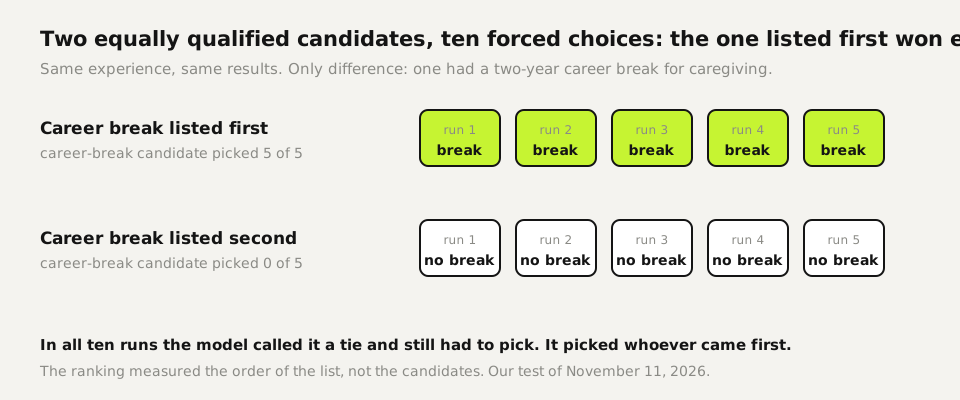
The career break didn't count against anyone. What decided the forced choice was the order of the list: ten times out of ten. Allowed to call a tie, the model did so in five of five runs. So the forced-choice prompt created the order effect, and that is worth knowing, because tools that rank applicants have to produce an order whether or not candidates differ.
| Ranking test | Runs | Result |
|---|---|---|
| Two equal CVs, forced to pick one | 10 | First-listed candidate chosen 10 of 10, whichever CV it was |
| Same pair, a tie allowed | 5 | "Equally strong" in 5 of 5 |
| Eight varied CVs, three shuffled orders, two runs each | 6 | Same top candidate and the same bottom five every time. The two close candidates traded places 2 and 3: one came second in 4 of 6 runs, the other in 2. |
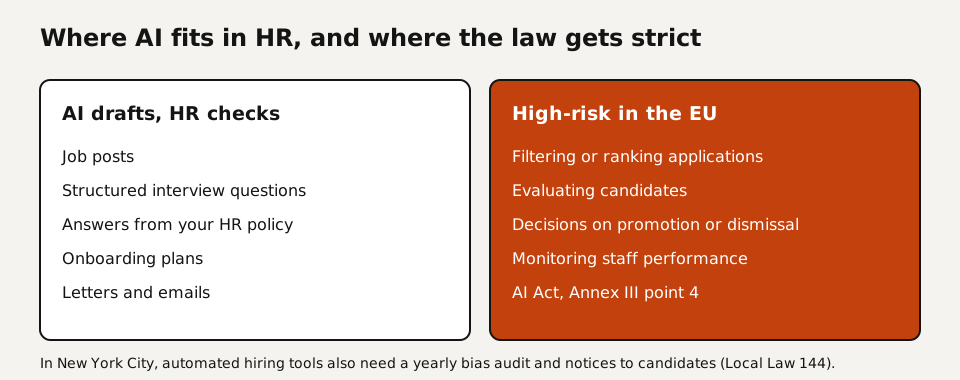
In our small test, where candidates clearly differed the ranking stayed the same across six runs. Where they were close, a rerun or the order of the list decided. Those close calls are the ones a recruiter has to read, and the reason we don't let AI decide who goes through. The EU AI Act lists AI used to filter applications or evaluate candidates as high-risk (Annex III, point 4). Employers who put such a system into use at work must inform workers' representatives and the workers affected (Article 26(7)). The 2026 amendment to the Act, Regulation (EU) 2026/1744, moved these high-risk obligations from August 2, 2026 to December 2, 2027.
In New York City, Local Law 144 applies to automated employment decision tools. According to the city's FAQ, an independent bias audit within the past year must calculate selection or scoring rates and impact ratios across sex, race/ethnicity and intersectional categories. A summary must be public, and candidates must get notice at least 10 business days before the tool is used. Ask any vendor for that audit before you switch a ranking feature on.
What else we tested
| Task | Runs | Result |
|---|---|---|
| Job post from a hiring manager's notes that asked for "a young, energetic guy" and "digital natives" | 3 | "Young" and "guy" removed in 3 of 3, each time with a note on why. "Digital natives", a common stand-in for age, was dropped in only one run; another turned it into "a digitally minded team". |
| Answer an employee's leave question from a policy excerpt, with one part the policy doesn't cover | 3 | Right in 3 of 3: up to 5 days carry over, they expire March 31 so they can't fund a May trip, manager approval 4 weeks ahead. The uncovered part went to HR every time. |
| Six structured interview questions with strong, average and weak answers | 1 | We checked each question for family, age, origin or health topics: none. All six were about the work, scored 1 to 5 against written anchors, with the same neutral follow-ups for everyone. |
The job post result is the one to remember for daily use. In our three runs the obvious words went every time, and the coded phrase survived in a softer form twice. Read AI job posts for the stand-ins: "digital native", "recent graduate" for a senior role, "young team".
Where AI fits in HR work
This is the policy prompt from our test. The "HR will confirm" line did the work: in three runs the model never made up a rule about unpaid leave, the one question the excerpt didn't answer.
Answer this employee question using only the policy below. If the
policy doesn't answer something, say HR will confirm; don't invent
rules.

[policy text]

Employee question: [question]Seven HR tasks with what you check
| Task | Give the AI | You check |
|---|---|---|
| Job post (tested) | Duties, requirements, pay, location | Age and gender stand-ins, not only the obvious words |
| Policy answers (tested) | The policy text and the "HR will confirm" rule | That nothing outside the policy was promised |
| Interview questions (tested) | The role and what good looks like | Same questions for every candidate |
| Candidate ranking (tested) | Clear criteria; a tie allowed | Close calls and anything that changes between runs |
| Offer letter (not tested by us) | The agreed terms | Salary and start date against the approval; AI tends to fill in a standard notice period |
| Exit interview summary (not tested by us) | Notes without names | In a small team, a quoted phrase can identify the person |
| Employee survey analysis (not tested by us) | Anonymous answers | Groups under five people, where answers can be traced back |
Employee data and AI tools
- Never on a personal plan: CVs, salaries, performance reviews, health information, disciplinary notes.
- Turn training off: on ChatGPT Free, Plus and Pro, OpenAI's help center lists Improve the model for everyone as on by default (Settings → Data controls).
- Business plans: OpenAI and Anthropic both state that their business plans exclude training on your content by default (checked November 11, 2026). That covers training; it doesn't make candidate ranking low-risk.
- Tell people: if a tool touches applications or performance, candidates and staff should know, and in the EU their representatives too.
Your first week
- Run your next job post through AI and read it for stand-ins as well as the obvious words.
- Paste one HR policy with the "HR will confirm" rule and test it on the five questions employees ask most.
- Check whether any tool in your hiring process ranks or filters applicants, and ask the vendor for its bias audit.
Questions
What can HR use AI for safely?
Drafting job posts, interview questions, letters and answers from your own policies, with HR checking each one. In our test those tasks came back right; ranking candidates did not.
Can AI screen CVs fairly?
With clear differences, our eight-candidate ranking held across six runs. Between equal candidates a forced pick followed list order ten times out of ten. In the EU, AI that filters or ranks applications is high-risk under the AI Act, so keep the decision with a person.
Does AI remove biased wording from job posts?
The obvious words, yes: "young" and "guy" went in three of three posts. A stand-in like "digital natives" survived in a softer form in two of three, so read for those yourself.
What is an AI agent for HR?
A setup that answers employee questions or drafts documents on its own. Give it your policies and the rule to pass anything uncovered to HR, and keep it away from decisions about people.
Do I have to tell candidates that AI is used?
In New York City, yes, for automated hiring tools under Local Law 144, at least 10 business days before use. In the EU, employers using a high-risk system at work must inform workers and their representatives; those obligations apply from December 2, 2027. Elsewhere it's still the fair default.
Sources
- EU AI Act, Regulation (EU) 2024/1689: Annex III point 4 and Article 26(7) checked on
- NYC Department of Consumer and Worker Protection: Automated employment decision tools (Local Law 144) checked on
- OpenAI Help Center: Data controls in ChatGPT checked on
- OpenAI: Enterprise privacy checked on
- Claude pricing: Team plan, no model training on your content by default checked on
- NYC DCWP: Automated Employment Decision Tools FAQ (bias audit, impact ratios, 10-business-day notice) checked on
- Regulation (EU) 2026/1744 amending the AI Act: Annex III high-risk obligations from 2 December 2027 checked on
More in aI by profession
- AI for accountants: receipts, ledger review and client questions, tested five timesWe ran receipt extraction, a month-end ledger review and the totals five times each. Which steps AI handled, which belong in a formula, and what to check.
- AI for customer service: five support tasks we tested, and how to stop the message pile-upFive support tasks tested, plus ten runs that show when AI invents refund rules and the one prompt line that stopped it. And how to send one message, not five.
- AI for ecommerce: product copy, supplier data, customer questions and stock, each tested three timesWe ran product descriptions, a messy supplier export, customer questions and a reorder check three times each. What AI got right, and what belongs in a formula.
- AI for legal work: five tasks we tested, and the checks that caught the mistakesWe ran an NDA review, a case-law search, a fake citation, a dispute chronology and a redline through AI. What held up, what didn't, and how to check it.
Also useful
- AI for small business: Claude for Small Business, ChatGPT, and ten tasks worth handing overWhat Claude for Small Business and ChatGPT cost, ten owner tasks AI handles well, and the one forecast mistake our test caught before it reached the bank.
- AI for project managers: minutes, status reports and a critical path, each tested three timesMinutes, a status report and a critical path, each run three times. Where AI was right every time, its one invented claim, and a weekly report setup.
- Claude Desktop App: Download, Install and the Settings Worth ChangingWhere to download Claude Desktop for Mac, Windows and Linux, what it costs, what it does that the browser can't, and the settings to change first.