Claude Sonnet vs Opus: what we found running the same eight tasks
For everyday work, Sonnet 5.5 is the better buy: on our eight-task test it matched Opus 5.5 on every answer at less than half the cost. Opus earns its price on writing that other people read and on long, multi-step jobs; Anthropic's own coding benchmarks favor it there. We ran Haiku 5.5, Sonnet 5.5, Opus 5.5 and Fable 5.2 through the same tasks on November 11, 2026. All four got all eight right, so the real differences were cost, formatting discipline and one subtle meaning error from Haiku.
Tested by us on 11 November 2026.
The current Claude models at a glance
| Model | Anthropic's description | API price in / out | Plans |
|---|---|---|---|
| Haiku 5.5 | High-volume, latency-sensitive tasks such as classification, extraction and routing | From $0.10 / $0.50 | Free and up |
| Sonnet 5.5 | The best combination of speed and intelligence | $2 / $10 | Free and up |
| Opus 5.5 | Long-running agentic coding and knowledge work; Anthropic's suggested starting point | $4 / $20 | Pro and up |
| Fable 5.2 | Demanding reasoning and long-horizon agentic work | $8 / $40 | Pro with paid usage credits; Max and Ultra up to half the weekly limit |
All four take text and images, use tools, and share a 1M-token context window, 128K tokens of maximum output and a June 2026 knowledge cutoff. On paper, speed and price are what separate them. Anthropic lists Haiku as fastest, Sonnet as fast, and Opus and Fable as moderate.
If you came here for Mythos: Anthropic says Claude Mythos 5.2 and Fable 5.2 are the same underlying model. Mythos is the version without the extra cyber and biology safeguards, and only vetted organizations get it through Anthropic's verification programs. For everyone else, Fable is the model you can use.
How we tested
Each model got the same prompts through Claude Code 2.1.321 in print mode (claude -p), with tools switched off and no custom settings, on a Linux machine. Every task had an answer we could verify. Time and cost come from Claude Code's JSON output for each call. Costs are at API rates and include Claude Code's own fixed system prompt, which is why even a one-line answer costs a fraction of a cent.
- Fix a function: Python code that counts working days, with an off-by-one end date and a missing national holiday. Checked against ten unit tests.
- Pull invoice data from an email: with a trap, because the email states one amount and then corrects it.
- Scheduling puzzle: five clients, five days, seven constraints, one valid schedule.
- Plain-language rewrite: a bureaucratic Dutch paragraph rewritten at B1 reading level, 70 words max, every fact kept.
- Contract review: a 13-article service agreement with two clauses that contradict each other.
- Hard logic puzzle: five coworkers, each with a day, department and tool, from eleven clues.
- Multi-step math: tiered discount, coupon, free-shipping threshold, a return and the sales tax in the final amount.
- Long document: find the final website budget in 9,000 words of meeting notes from 40 meetings, past three earlier decisions and a different project with its own budget.
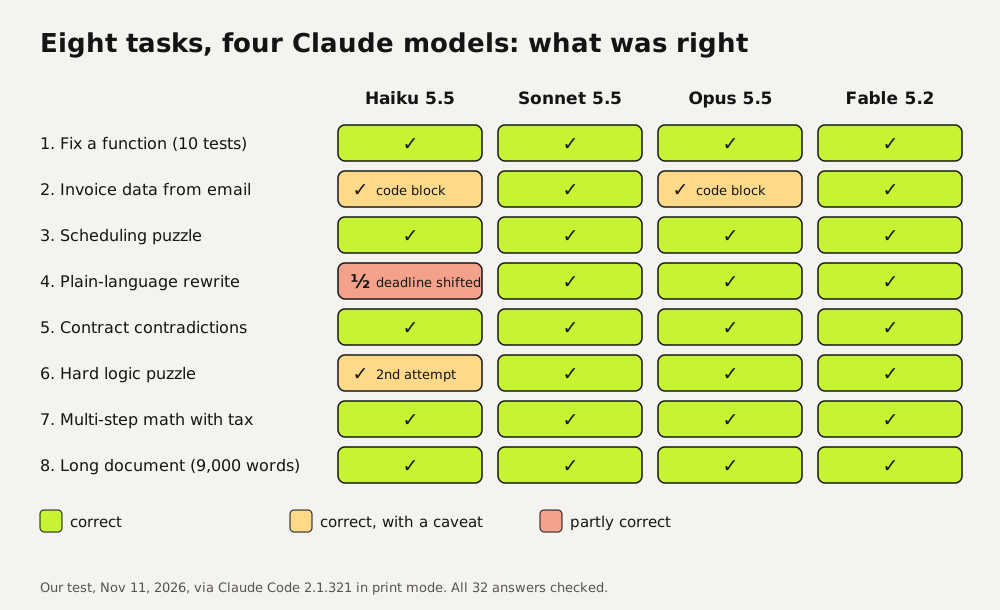
Results: all four models got the answers right
| Task | Haiku 5.5 | Sonnet 5.5 | Opus 5.5 | Fable 5.2 |
|---|---|---|---|---|
| 1. Fix a function | Correct | Correct | Correct | Correct |
| 2. Invoice data | Correct, but wrapped the JSON in a code block | Correct | Correct, but wrapped the JSON in a code block | Correct |
| 3. Scheduling puzzle | Correct | Correct | Correct | Correct |
| 4. B1 rewrite | Partial: changed 'no later than' to 'before' | Correct | Correct | Correct |
| 5. Contract review | Correct | Correct | Correct | Correct |
| 6. Hard logic puzzle | Correct on the second attempt | Correct | Correct | Correct |
| 7. Multi-step math | Correct | Correct | Correct | Correct |
| 8. Long document | Correct | Correct | Correct | Correct |
Haiku made the only content error. In the plain-language rewrite, the source said applications must arrive no later than January 31; Haiku wrote 'before January 31', which moves the deadline by a day. It reads fine, which is the problem. Haiku's first attempt at the hard puzzle also returned nothing after ten minutes, so we killed it. A second run solved it in under ten seconds.
Formatting is where automations break. We asked for bare JSON on the invoice task. Sonnet and Fable returned exactly that; Haiku and Opus wrapped it in a Markdown code block. A person won't notice. A script that parses the reply will fail, so validate the format before anything downstream uses it.
On the rewrite, Opus and Fable produced the most readable text: a question as the opening line and the three required documents as a list. Sonnet stayed closer to the original phrasing. That's a style difference, and for a quick internal memo it doesn't matter.
What each model cost per task
| Haiku 5.5 | Sonnet 5.5 | Opus 5.5 | Fable 5.2 | |
|---|---|---|---|---|
| Five everyday tasks, total | $0.003 | $0.040 | $0.102 | $0.203 |
| Average per everyday task | $0.0006 | $0.008 | $0.020 | $0.041 |
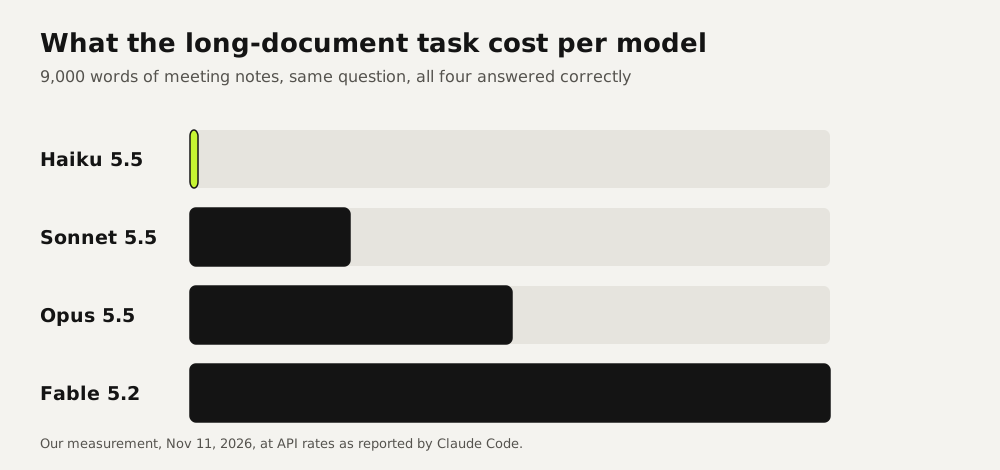
| Long document (9,000 words) | $0.006 | $0.114 | $0.230 | $0.457 |
| Time per task | 1.6 to 10 seconds | 1.3 to 6.5 seconds | 2 to 8.5 seconds | 1.8 to 5.7 seconds |
Opus cost two to two and a half times as much as Sonnet for the same correct answers, and Fable about twice as much as Opus. Haiku read the 9,000-word document for one twentieth of Sonnet's price.
On a subscription you don't pay per task, but the same ratio shows up as usage: a heavier model burns through your 5-hour and weekly limits faster. Our Claude pricing page lists which models each plan includes and what the plans cost.
When to use Sonnet, Opus, Haiku or Fable
- Sonnet 5.5 for most daily work: email, summaries, spreadsheets, everyday code. It was correct on every task and the fastest overall.
- Opus 5.5 for text that goes out under your name and for long agentic jobs with many steps. Anthropic publishes a lead for Opus over earlier models on long coding benchmarks; our short tasks didn't need that headroom.
- Haiku 5.5 for high-volume extraction, sorting and lookup where the answer can be checked. Keep a human or a validation step on anything customers read.
- Fable 5.2 for the hardest reasoning and agents that work for hours. On our eight tasks it added nothing Sonnet didn't deliver; its edge is in longer, harder work than we gave it.
Anthropic's own benchmark table backs the split for coding. On FrontierSWE v2 it reports 69.9% for Fable 5.2 and 62.3% for Opus 5.5. Those are vendor numbers on long software tasks. If your own work doesn't show the gap, the cheaper model is the right call.
Run the comparison on your own task
The most useful benchmark is one of your own tasks. With Claude Code installed, this command prints the answer, duration and API-rate cost for one model. Swap the model name and compare.
claude -p "Extract the invoice number, amount and due date from this email: ..." \
  --model claude-sonnet-5-5 --output-format json --tools ""
The JSON output includes result, duration_ms and total_cost_usd.
We have no paid relationship with Anthropic. We rerun this test when a new model ships and date the results on this page.
Questions
Is Claude Opus better than Sonnet?
On our eight tasks they were equally accurate. Opus wrote more readable plain-language text and cost two to two and a half times as much. Anthropic's benchmarks show Opus pulling ahead on long, complex coding work.
When is Haiku good enough instead of Sonnet?
For tasks with a checkable answer: extraction, classification, finding a fact in a long document. Haiku did those correctly at a fraction of Sonnet's cost. In customer-facing text it made a meaning error Sonnet didn't.
What is the newest Claude model?
Fable 5.2, which became the default Fable model in Claude Code on November 9, 2026. Mythos 5.2 launched the same day for vetted organizations only.
Which Claude models come with Free, Pro and Max?
Free includes Sonnet and Haiku. Pro adds Opus, plus Fable through paid usage credits. Max and Ultra include Fable for up to half the weekly limit.
What's the difference between Claude Fable and Mythos?
According to Anthropic they're the same underlying model. Mythos drops some safeguards for cybersecurity and biology research and is limited to vetted organizations.
Sources
More in pricing and comparisons
- Claude pricing: what every plan costs and what you getClaude Free, Pro, Max, Ultra, Team and Enterprise prices from the official page, what changed in 2026, and three questions to pick a plan.
- Claude API pricing: what real tasks cost per modelClaude API prices per million tokens, plus measured costs for five tasks in dollars and euros: 100 invoices cost under $0.90 on Sonnet 5.5.
- Claude Code pricing: plans, limits and what one task costsClaude Code plans from $20 a month, plus our test: a coding task averaged $0.28 on Opus 5.5 and $0.09 on Sonnet 5.5. When the API is cheaper.
- Is Claude Code free? What it costs and the cheapest ways to use itClaude Code is free to install but needs a paid plan or API credit. We measured what a task costs and tested the spend cap that keeps it cheap.
Also useful
- AI for accountants: receipts, ledger review and client questions, tested five timesWe ran receipt extraction, a month-end ledger review and the totals five times each. Which steps AI handled, which belong in a formula, and what to check.
- AI for customer service: five support tasks we tested, and how to stop the message pile-upFive support tasks tested, plus ten runs that show when AI invents refund rules and the one prompt line that stopped it. And how to send one message, not five.
- AI for ecommerce: product copy, supplier data, customer questions and stock, each tested three timesWe ran product descriptions, a messy supplier export, customer questions and a reorder check three times each. What AI got right, and what belongs in a formula.