Claude Skills vs. MCP vs. Plugins vs. Subagents: Which One for Which Job
Use a skill for know-how Claude Code needs now and then, and CLAUDE.md for the few facts it needs every time. Add an MCP server when it has to reach another system, a subagent when work should happen in a separate context, and a plugin to package any of those for others. The numbers behind the first choice: we gave Claude Code the same 4,500-word style guide as a skill and as CLAUDE.md. As a skill it cost 60 tokens in a session that didn't need it; in CLAUDE.md it cost 8,825 tokens every time. Both produced the right result when the guide mattered.
Tested by us on 11 November 2026.
The short answer
| Skill | CLAUDE.md | MCP server | Subagent | Plugin | |
|---|---|---|---|---|---|
| What it is | A SKILL.md with instructions, loaded when relevant or with /name | A file Claude Code reads at the start of every session | A connection that gives Claude Code tools for another system | A helper with its own context window and instructions | A package of skills, subagents, hooks and MCP servers |
| Costs context | Its description, until used | All of it, every session | Tool names; tool search is on by default | Only its summary in your session | The descriptions of everything inside it |
| Use it for | Procedures and reference you need sometimes | Short rules that always apply | Reading or changing data elsewhere: GitHub, a database, Drive | Side work whose output you don't want in your session | Sharing a setup with a team or across projects |
| Not for | Rules that must hold every time | Long reference material | Know-how without an outside system | Quick tasks, or work that needs back-and-forth | A single file you could copy |
Pick a skill for know-how Claude Code needs some of the time, and CLAUDE.md for short rules that always apply. Pick MCP to reach another system, a subagent to keep side work out of your session, and a plugin to hand all of it to someone else.
How we tested it
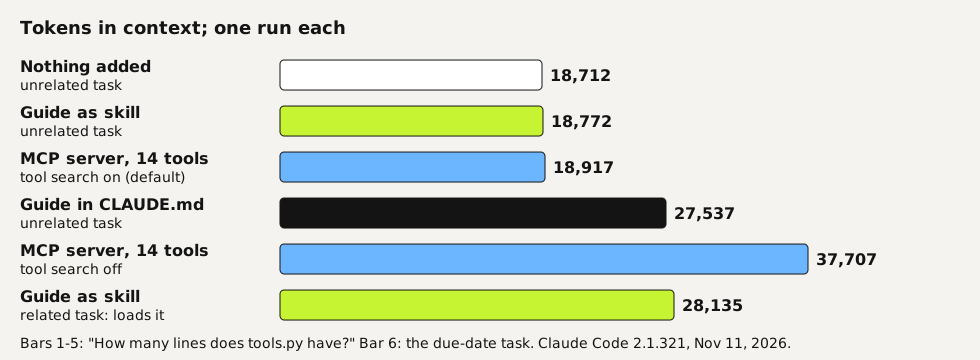
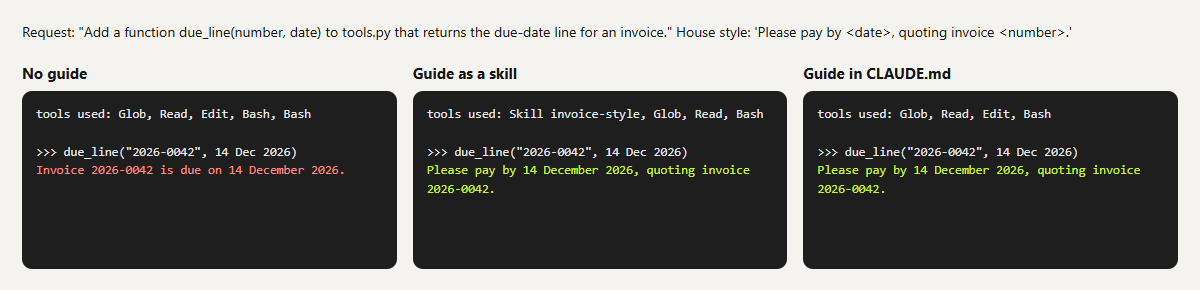
We wrote a 4,500-word invoice style guide: 120 general wording rules and one exact rule for the due-date line, "Please pay by <date>, quoting invoice <number>." We put it in three empty Python projects. One had it as CLAUDE.md, one as a skill in .claude/skills/invoice-style/SKILL.md with a two-sentence description, and one had no guide. Each project got two tasks in a fresh Claude Code 2.1.321 session: an unrelated one ("How many lines does tools.py have?") and a related one ("Add a function due_line(number, date)"). We read the token counts from the session logs and ran the function ourselves. We repeated the related task with the skill two more times, and added a fourth project with an MCP server. All tests ran on Ubuntu; the screenshots were rendered on a Windows PC.
| Setup | Unrelated task: context, cost | Related task: guide used? | Due-date line produced |
|---|---|---|---|
| No guide | 18,712 tokens, $0.028 | No | "Invoice 2026-0042 is due on 14 December 2026." (wrong wording) |
| Guide as a skill | 18,772 tokens, $0.028 | Yes, loaded by Claude Code itself in 3 of 3 runs | "Please pay by 14 December 2026, quoting invoice 2026-0042." (3 of 3) |
| Guide in CLAUDE.md | 27,537 tokens, $0.064 | Yes, it was already loaded | "Please pay by 14 December 2026, quoting invoice 2026-0042." |
| MCP filesystem server (14 tools), tool search on | 18,917 tokens, $0.029 | Not applicable | Not applicable |
| Same MCP server, tool search off | 37,707 tokens, $0.157 | Not applicable | Not applicable |
 (opens at full size)
What the numbers mean
Context. A skill's description was all that sat in context until the task called for it: 60 extra tokens. The same text in CLAUDE.md added 8,825 tokens to every session, related or not, and more than doubled the cost of the unrelated task, from $0.028 to $0.064. At 50 short sessions a day, that is about 440,000 tokens spent on a guide most of those sessions never needed.
Reliability. Here both worked. Claude Code matched the request to the skill's description and loaded it on its own. That depends on the description: Anthropic's docs say descriptions are cut at 1,536 characters in the skill list, so put the trigger words first. A rule that must hold in every session, like how money is rounded, belongs in CLAUDE.md, where Claude Code can't skip loading it.
Commands. Custom commands in .claude/commands/ and skills now create the same /name, according to the docs, and existing command files keep working. A skill adds a folder for supporting files and lets Claude Code load it without being asked. For anything new, we write a skill.
Where MCP, subagents and plugins fit
MCP is about reach, not knowledge. An MCP server adds tools: read issues on GitHub, query a database, open a file in Drive. You add one with claude mcp add, at local, project or user scope. We connected the official filesystem server, which brings 14 tools. With tool search on, the default, it added 205 tokens to an unrelated task. With ENABLE_TOOL_SEARCH=false it added 18,995 and the task cost $0.157 instead of $0.028. A skill can tell Claude Code how to use such tools well, so the two often go together.
Subagents are about where work happens. In our subagent tests a separate context shrank the main conversation by 8% at best on two small tasks, while sessions cost 1.6 to 2.4 times as much. A reviewer subagent with a fresh context did find two planted bugs. A skill can also run in its own subagent context with context: fork in its frontmatter.
Plugins are about distribution. Skills, subagents, hooks and MCP servers all work without a plugin. A plugin bundles them so a team can install one unit from a marketplace and get updates. The docs warn that every enabled plugin adds its skill and agent descriptions to every session, so turn off plugins you don't use.
What we use ourselves
Our main instruction file holds about twenty hard rules, each with a date and a reason. Everything else lives in 96 skills, from code review to writing checks. The instruction file only names the kinds of skills in a few lines, and the skills load themselves on their descriptions. The weak spot is the description. Some third-party skills come with long descriptions that crowd the list, so a small script shortens them back to two sentences, trigger words first, after every update. For the rules side, see our CLAUDE.md guide.
Questions
What is the difference between Claude skills and MCP?
A skill is know-how: instructions Claude Code loads when a task needs them. MCP is reach: a server that gives Claude Code tools for another system. Use a skill to teach how, MCP to give access.
Should I use a skill or CLAUDE.md?
CLAUDE.md for short rules that apply every time; a skill for longer procedures or reference that only some tasks need. In our test the same guide cost 8,825 tokens per session in CLAUDE.md and 60 as a skill.
Are slash commands the same as skills now?
According to Claude Code's docs, custom commands have been merged into skills: a file in .claude/commands/ and a skill in .claude/skills/ both create the same /name. Skills can also be loaded by Claude Code on its own.
Do I need a plugin to use skills?
No. Save a skill in .claude/skills/ in your project or ~/.claude/skills/ for all projects. Plugins are for packaging and sharing. We have no paid relationship with any of the tool makers mentioned here.
Sources
- Claude Code: Extend Claude with skills checked on
- Claude Code: Connect to tools via MCP checked on
- Claude Code: Plugins overview checked on
- Claude Code: Create custom subagents checked on
More in claude in practice
- CLAUDE.md and Claude Code Memory: A Template We TestedHow Claude Code memory works through CLAUDE.md, with a template we tested: rules that stick, background files that load only when needed, and AGENTS.md.
- Claude Code Subagents: When They Help, and When They Only Cost MoreWe tested Claude Code subagents on real tasks: little context saved, up to twice the cost, and a reviewer that took the author's view. Two subagent files.
- Claude Code Templates: Seven Files, Tested One by One and Then TogetherSeven Claude Code template files we use: CLAUDE.md, settings, a blocking hook, two subagents, a status line and a loop. Each tested, then all together.
- The Best Claude Skills: We Tested Ten Against Claude Code Without ThemWe ran ten popular Claude skills on a real task, once with the skill and once without. Three earned a place. Full scores, the ones we dropped and why.
Also useful
- How to Build an MCP Server: A Tested Python and Node ExampleBuild a working MCP server in Python or Node, test it without a model, inspect it, then connect it to an AI app. Full code and the errors we hit.
- Building n8n workflows with Claude Code: what works and what you still checkClaude Code built, validated and tested three n8n workflows through n8n's MCP server. What worked, what you still check yourself, and the prompt to copy.
- Claude marketing skills: a copy check and an SEO check, tested with and without the skillTwo Claude marketing skills, a copy check and an SEO page check, tested with and without the skill. The SKILL.md files are on this page.