Claude API pricing: what real tasks cost per model
The Claude API charges per million tokens: $0.10 in and $0.50 out for Haiku 5.5, $2 and $10 for Sonnet 5.5, and $4 and $20 for Opus 5.5. We measured five everyday tasks to turn that into real money. Reading 100 invoices into structured data cost under $0.90 (about €0.78) on Sonnet 5.5, and summarizing a 12-page contract cost three cents.
Tested by us on 11 November 2026.
The API and a Claude subscription are separate products. Pro, Max and Ultra are flat monthly plans for the Claude apps and Claude Code. The API is for your own software, scripts and automations, and it bills every token. If you are looking for plan prices, see our Claude pricing overview.
Claude API prices per million tokens
| Model | Input | Output | Cache write (5 min) | Cache read | Batch input / output |
|---|---|---|---|---|---|
| Haiku 5.5 | $0.10 | $0.50 | $0.125 | $0.01 | $0.05 / $0.25 |
| Sonnet 5.5 | $2 | $10 | $2.50 | $0.10 | $1 / $5 |
| Opus 5.5 | $4 | $20 | $5 | $0.20 | $2 / $10 |
| Fable 5.2 | $8 | $40 | $10 | $0.20 | $4 / $20 |
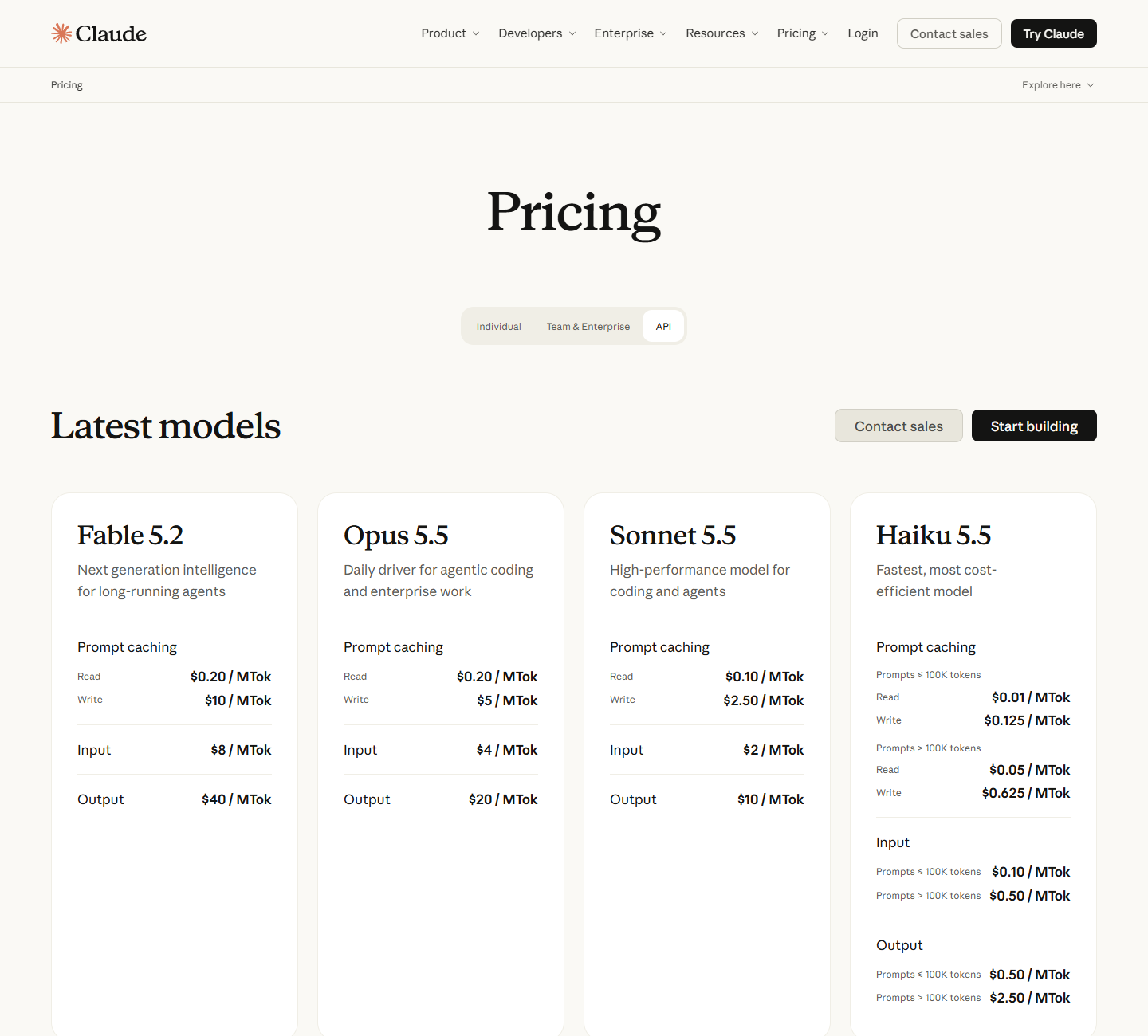 (opens at full size)
A token is a piece of a word. Our 5,644-word contract came to about 10,900 input tokens, close to two tokens per word, because legal text is full of punctuation and long terms. Output costs five times as much as input on every model in the table, so long answers drive the bill more than long prompts.
What five everyday tasks cost, measured
We sent five ordinary business tasks to each model and recorded the exact token counts the API returned. The inputs were a customer complaint email, a one-page invoice, a 5,644-word license agreement (the GPL-3.0 text) and a short product brief. Each task ran once per model with a one-line system prompt and no tools.
| Task | Input tokens | Output Haiku 5.5 | Output Sonnet 5.5 | Output Opus 5.5 |
|---|---|---|---|---|
| Summarize a customer email | 388 | 578 | 341 | 320 |
| Draft a reply to that email | 407 | 1,321 | 969 | 1,227 |
| Extract an invoice to JSON | 512 | 974 | 776 | 769 |
| Summarize a 12-page contract | 10,897 | 1,462 | 814 | 740 |
| Write a product page from a brief | 150 | 2,538 | 744 | 1,695 |
| Task, 100 times | Haiku 5.5 | Sonnet 5.5 | Opus 5.5 |
|---|---|---|---|
| Summarize a customer email | $0.03 (€0.03) | $0.42 (€0.37) | $0.80 (€0.71) |
| Draft a reply to that email | $0.07 (€0.06) | $1.05 (€0.94) | $2.62 (€2.34) |
| Extract an invoice to JSON | $0.05 (€0.04) | $0.88 (€0.78) | $1.74 (€1.55) |
| Summarize a 12-page contract | $0.18 (€0.16) | $2.99 (€2.67) | $5.84 (€5.21) |
| Write a product page from a brief | $0.13 (€0.12) | $0.77 (€0.69) | $3.45 (€3.08) |
We ran the invoice task three times per model to see how much the output moves between runs. Output varied by up to 10 percent, so the cost of 100 invoices ranged from $0.84 to $0.88 on Sonnet 5.5 and from $1.74 to $1.88 on Opus 5.5. Read the other rows with that margin in mind; they come from a single run.
What the token counts did not show
Price per task is only half the answer. Our test invoice turned out to contain an error we did not plant: the sales tax line did not match 8.25% of the discounted product total. All three models extracted every field correctly in every run. Opus 5.5 pointed out the wrong tax in all three runs, Haiku 5.5 in one of three and Sonnet 5.5 in none.
Haiku 5.5 also surprised us on output. It used built-in reasoning on every task and wrote more tokens than Sonnet, up to 2,538 for the product page. Because its output price is twenty times lower, it was still the cheapest model by far. If you budget by output tokens rather than dollars, keep that in mind.
How much prompt caching and the Batch API save
Prompt caching pays off when a large, fixed part of the prompt comes back again and again. Take the contract: ask Sonnet 5.5 ten questions about it within five minutes. Without caching you pay for 10,897 input tokens ten times, about $0.22. With caching the first call writes the cache for $0.027 and the nine reads cost $0.010 together. That is $0.037, which cuts input cost by 83%.
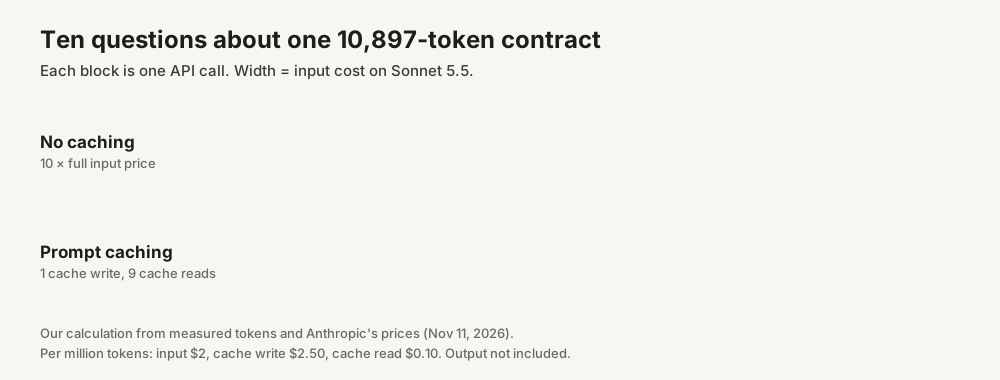
For the 100 invoices caching does almost nothing, because the fixed instruction is only about 60 tokens and every invoice is different. That job suits the Batch API instead: half price on input and output. Anthropic's batch docs say most batches finish within an hour, and a batch expires if it is not done within 24 hours. The Sonnet invoice run drops from $0.88 to $0.44. Batch and caching discounts stack, according to the pricing docs.
| Job | Plain API | With caching | With Batch |
|---|---|---|---|
| 10 questions about one contract (Sonnet 5.5, input only) | $0.218 | $0.037 | $0.109 |
| 100 invoices to JSON (Sonnet 5.5) | $0.88 | about $0.88 | $0.44 |
How to avoid a surprise bill
- Know your tier's ceiling. Every organization has a monthly spend cap set by its usage tier: $500 on Start, $1,000 on Build and $200,000 on Scale. That protects Anthropic more than it protects you.
- Set your own limit below it. In the Claude Console under Billing, open Spend limits and choose Set limit. When you reach it, requests fail with
You have reached your specified API usage limitsuntil the next month or until you raise it. - Give each project its own workspace with its own spend and rate limits. A runaway script then stops at its own ceiling and leaves your other work alone. The default workspace cannot have a spend limit, so do not run production on it.
- Cap the answer length with
max_tokenson every call. Output is the expensive half. - Pick the model per step. Extraction and sorting run fine on Haiku; save Opus for the step where a mistake costs real money, like checking the invoice total.
Claude API or Claude Pro?
Pro ($20 a month) covers your own work in the Claude apps and Claude Code. It does not give you an API key for your own software. The API has no monthly fee and bills per token, so a script that summarizes ten emails a day on Sonnet 5.5 costs about $1.30 a month. Max and Ultra include $100 and $200 of monthly API credit for building on the Claude Platform, according to the pricing page.
How Claude compares with the OpenAI API
We did not put OpenAI prices in this table. OpenAI's pricing pages block automated checks and load their figures with scripts, so we cannot keep them current here without a person checking by hand. The fair way to compare is to take the token counts above and apply each provider's price list on the same day. Token counts differ a little between providers because each uses its own tokenizer.
Questions
How much does a Claude API token cost?
Per million tokens: Haiku 5.5 costs $0.10 input and $0.50 output, Sonnet 5.5 $2 and $10, Opus 5.5 $4 and $20 (checked November 11, 2026). One token is a piece of a word.
What does it cost to summarize an email or read 100 invoices?
In our test an email summary cost $0.0042 on Sonnet 5.5. Extracting 100 one-page invoices to JSON cost $0.84 to $0.88 on Sonnet 5.5 (about €0.78), $0.05 on Haiku 5.5 and $1.74 to $1.88 on Opus 5.5.
How much do prompt caching and the Batch API save?
Caching saved 83% of input cost when we asked ten questions about the same contract. The Batch API halves the price of everything and suits jobs like bulk invoice extraction that can wait up to a day.
What is the difference between Claude Pro and the API?
Pro is a $20 monthly plan for the Claude apps and Claude Code. The API is pay-per-token access for your own software and has no monthly fee.
How do I prevent an unexpectedly high bill?
Set your own spend limit in the Claude Console, give each project a workspace with its own limit, cap max_tokens and use the smallest model that does the job.
Is Claude cheaper than the OpenAI API?
We have not verified OpenAI's current prices, because its pricing pages block automated checks. Apply both price lists to the token counts on this page on the same day to compare.
Sources
- Claude API docs: Pricing (models, caching, batch) checked on
- Claude API docs: Models overview checked on
- Claude API docs: Batch processing checked on
- Claude API docs: Rate limits and spend limits checked on
- Claude: Plans and pricing checked on
- GNU GPL 3.0 text (test document) checked on
- ECB euro reference rate USD (November 10, 2026: 1.1214) checked on
More in pricing and comparisons
- Claude pricing: what every plan costs and what you getClaude Free, Pro, Max, Ultra, Team and Enterprise prices from the official page, what changed in 2026, and three questions to pick a plan.
- Claude Code pricing: plans, limits and what one task costsClaude Code plans from $20 a month, plus our test: a coding task averaged $0.28 on Opus 5.5 and $0.09 on Sonnet 5.5. When the API is cheaper.
- Claude Sonnet vs Opus: what we found running the same eight tasksWe gave Haiku 5.5, Sonnet 5.5, Opus 5.5 and Fable 5.2 the same eight checkable tasks. Accuracy, cost per task and where each model fits.
- Is Claude Code free? What it costs and the cheapest ways to use itClaude Code is free to install but needs a paid plan or API credit. We measured what a task costs and tested the spend cap that keeps it cheap.