Claude Code pricing: plans, limits and what one task costs
Claude Code is included in every paid Claude plan: Pro at $20 a month, Max at $100 and Ultra at $200. You can also skip the subscription and pay per token through the API. We ran five everyday coding tasks three times per model: one task averaged $0.28 at API rates with Opus 5.5 and $0.09 with Sonnet 5.5. The same tasks in one long session cost two and a half times as much.
Tested by us on 11 November 2026.
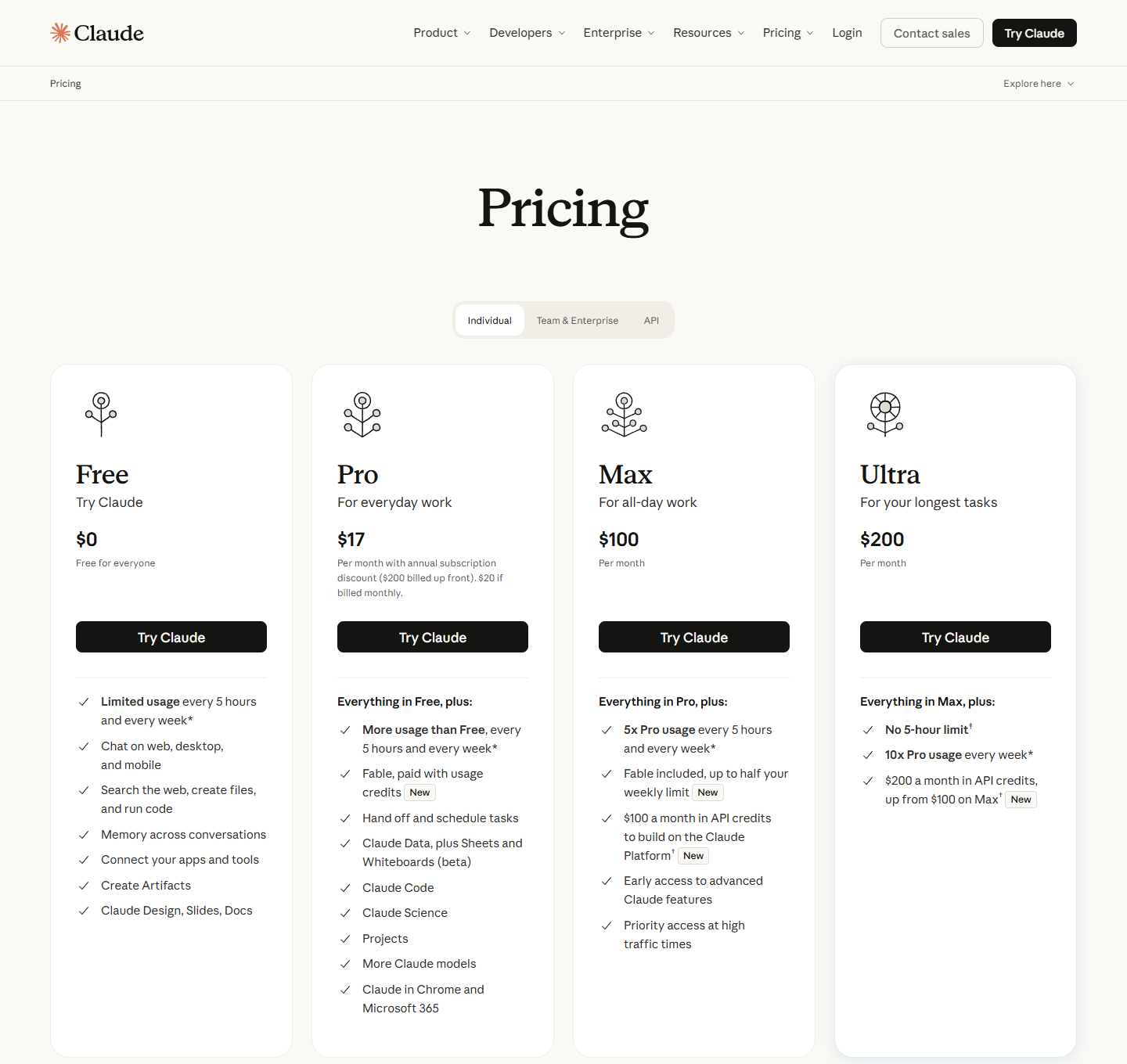
Claude Code plans and prices on November 11, 2026
 (opens at full size)
| Plan | Price | Claude Code | Usage allowance (Anthropic's wording) |
|---|---|---|---|
| Free | $0 | Not included | Limited usage every 5 hours and every week |
| Pro | $20 a month, or $200 a year (about $17 a month) | Included | More usage than Free, every 5 hours and every week |
| Max | $100 a month | Included | 5 times Pro usage, every 5 hours and every week |
| Ultra | $200 a month | Included | 10 times Pro usage per week, with no 5-hour limit for verified accounts |
| Team, standard seat | $25 a seat a month, or $20 billed yearly | Included | More usage than Pro |
| Team, premium seat | $125 a seat a month, or $100 billed yearly | Included | 5 times a standard seat |
| Enterprise | $20 a seat a month, plus all usage billed at API rates | Included | Pay for what you use |
| API through the Console | No subscription; you pay per token | Included | No plan limit; you set a spend cap |
Max and Ultra also include monthly API credit ($100 and $200) for building on the Claude Platform. For every plan side by side, including what changed this year, see our Claude pricing overview.
What one task cost in our test
We gave Claude Code five tasks that look like ordinary development work, on an open-source Python library of 575 lines (python-slugify, pinned to one commit). Every task ran three times per model, each time in a fresh session with personal settings, plugins and instruction files switched off (--safe-mode). Claude Code reports the cost of each session at API list price; the table shows the lowest and highest of the three runs.
| Task | Opus 5.5 (3 runs) | Sonnet 5.5 (3 runs) |
|---|---|---|
| Find and fix a reported bug | $0.17 to $0.19 | $0.03 to $0.05 |
| Add a feature with tests | $0.43 to $0.48 | $0.13 to $0.15 |
| Refactor a function, same behavior | $0.19 to $0.22 | $0.05 |
| Write tests for untested code | $0.28 to $0.33 | $0.08 to $0.12 |
| Update README and changelog | $0.25 to $0.30 | $0.10 to $0.11 |
| All five tasks | $1.37 to $1.46, about 4 minutes | $0.41 to $0.47, about 1.5 minutes |
The cost of a full set varied by at most 15 percent between runs, so the averages are usable: $0.28 per task with Opus 5.5 and $0.09 with Sonnet 5.5. Sonnet was three times cheaper and more than twice as fast. It was also less careful once: in its first run it edited the README without running the tests, and a test that executes the README examples failed. In one Opus run the new tests exposed what looks like a real bug in the library; Opus left that test failing on purpose and reported it.
Does a bigger codebase cost more per task?
Not in our run. We repeated the bug fix in click, a command-line library with about 13,000 lines of source and 16,000 lines of tests. Opus 5.5 found the planted bug, fixed it and added a regression test for $0.17 in 44 seconds. Sonnet 5.5 did the same for $0.06 in 22 seconds, and all 2,600 tests passed for both. Claude Code searches for the code it needs, so the size of the project barely moved the price.
Long sessions cost more than the tasks in them
What does move the price is the length of a session. We ran the same five tasks with Opus 5.5 one after another in a single session. The total came to $3.59, against $1.46 in five fresh sessions. Every turn sends the whole conversation so far, so each task paid for all the ones before it: the last one cost $1.24 instead of $0.30.
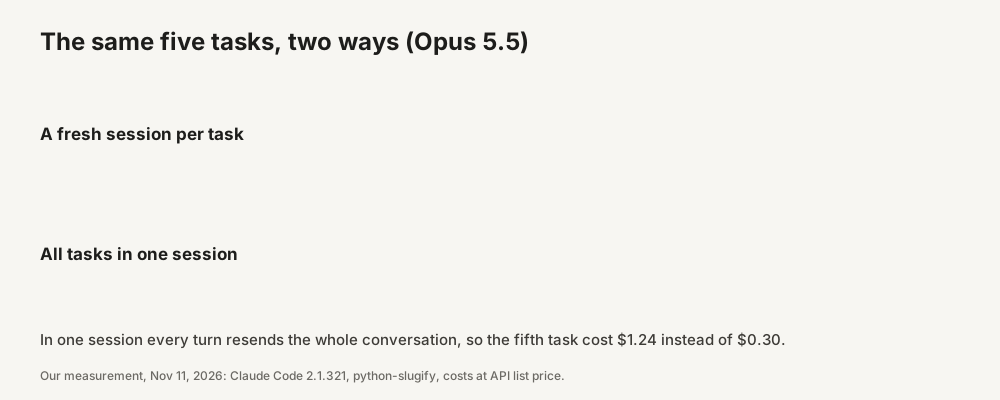
That explains most of the gap with Anthropic's own figure for companies. Its cost documentation says enterprise deployments average about $13 per developer per active day, $150 to $250 per month, with 90 percent of users under $30 per active day (checked November 11, 2026). Start a new session with /clear when you switch to an unrelated task and you pay for the task, not for the history.
What Claude Code costs per month
The table scales our averages to 21 working days, with each task in its own session. If you keep long sessions open, multiply by two to three.
| Use | Tasks per working day | Opus 5.5 on the API | Sonnet 5.5 on the API |
|---|---|---|---|
| Light | 3 | about $18 a month | about $6 a month |
| Typical | 15 | about $89 a month | about $28 a month |
| Heavy | 50 | about $295 a month | about $92 a month |
When the API is cheaper than a subscription
Pro costs $20 a month. With our averages the API stays below that up to about ten Sonnet tasks or three Opus tasks per working day, in fresh sessions. Above that line Pro is cheaper on paper, as long as its usage limit lets you do the work. Pay-as-you-go also suits occasional bursts, a team that wants a spend cap per person, and scripts that run Claude Code unattended.
We did not run a Pro account into its limit for this page, and Anthropic does not publish the limits in tokens or dollars. So we cannot tell you how many of our tasks fit in Pro's five-hour window. The difference in risk is clear: a plan has a fixed price and stops you at the limit, while the API keeps going and keeps billing.
What happens when you hit the usage limit
- Every plan has a five-hour window and a weekly limit. Ultra drops the five-hour window for verified accounts. Chats on claude.ai and work in Claude Code draw from the same pool.
- At the limit you have three options: wait for the reset, move to a higher plan, or turn on usage credits. Usage credits let you keep working on Pro, Max or Ultra at standard API rates.
- Check where you stand in Settings > Usage on claude.ai, or with
/usagein Claude Code. The dollar figure in/usagematters only on the API; subscribers see usage bars. - Measure your own pace: open
/usagebefore and after a typical task and note how far the five-hour bar moved. Two or three tasks tell you more than any table, ours included.
How to cap what Claude Code can spend
On the API you can stop a single unattended run at a dollar amount with --max-budget-usd. We tested it on the feature task with Opus 5.5 and a cap of $0.10. Claude Code stopped after three turns at $0.105 and returned Reached maximum budget ($0.1). It checks the cap between turns, so expect a small overshoot. No file had changed yet.
claude -p "Add a max_words option with tests" --max-budget-usd 0.10 --output-format jsonPrint mode (-p) only. For a team, set a spend limit per workspace in the Claude Console; on Team and Enterprise plans an admin sets limits in the admin settings.
Which option to pick
- Fewer than ten Sonnet tasks a working day? The API with a spend cap is cheaper than Pro. Take Pro anyway if you also want the chat app.
- Coding with it every working day? Take Pro. If
/usageshows you reaching the five-hour limit more than once a week, move to Max. - Long sessions or several agents at once? Measure a week with
/usagefirst, then choose between Max and Ultra.
Questions
How much does Claude Code cost per month?
Claude Code comes with Pro ($20 a month, or $17 a month billed yearly), Max ($100) and Ultra ($200). On the API you pay per token: in our test one coding task averaged $0.28 with Opus 5.5 and $0.09 with Sonnet 5.5.
Is Claude Code included in the free plan?
No. The comparison table on claude.com/pricing marks Claude Code as not included in Free (checked November 11, 2026). Our page Is Claude Code free? covers the cheapest routes.
Is the $20 Pro plan enough for Claude Code?
For a few tasks a day, usually yes. Pro shares one usage pool between chat and Claude Code, with a five-hour window and a weekly limit. If you hit the limit regularly, Max gives five times the usage.
What does Claude Code cost in euros?
Anthropic bills in dollars, also in Europe. At the ECB rate of November 10, 2026 (1 EUR = 1.1214 USD), Pro is €17.83 a month, Max €89.17 and Ultra €178.35, before VAT.
When is the API cheaper than a subscription?
In our test, up to about ten Sonnet tasks or three Opus tasks per working day, each in a fresh session. Above that, Pro costs less, as long as its limit covers your work.
How quickly do you hit the usage limit, and what happens then?
Anthropic does not publish fixed numbers and we did not measure Pro's limit. At the limit you wait for the reset, upgrade, or turn on usage credits at API rates.
Do we earn a commission if you buy a plan?
No. We have no paid relationship with Anthropic and use no affiliate links.
Sources
- Claude: Plans and pricing checked on
- Claude Code docs: Manage costs effectively checked on
- Claude API docs: Pricing checked on
- Claude Code docs: CLI reference (--max-budget-usd) checked on
- ECB euro reference rate USD (November 10, 2026: 1.1214) checked on
- python-slugify (test repository) checked on
- click (larger test repository) checked on
More in pricing and comparisons
- Claude pricing: what every plan costs and what you getClaude Free, Pro, Max, Ultra, Team and Enterprise prices from the official page, what changed in 2026, and three questions to pick a plan.
- Is Claude Code free? What it costs and the cheapest ways to use itClaude Code is free to install but needs a paid plan or API credit. We measured what a task costs and tested the spend cap that keeps it cheap.
- Claude API pricing: what real tasks cost per modelClaude API prices per million tokens, plus measured costs for five tasks in dollars and euros: 100 invoices cost under $0.90 on Sonnet 5.5.
- Claude Code changelog explained: what changed November 2-10, 2026The Claude Code changelog for November 2-10, 2026 in plain English: what to use, what might break, and what we tested. Latest version: 2.1.322.
Also useful
- AGENTS.md Explained: One Instruction File for Codex, Claude Code and Other AgentsAGENTS.md is the shared instruction file for coding agents. How Codex reads it, when Claude Code does, and the one-line fix we tested.
- How to Build an MCP Server: A Tested Python and Node ExampleBuild a working MCP server in Python or Node, test it without a model, inspect it, then connect it to an AI app. Full code and the errors we hit.
- Building n8n workflows with Claude Code: what works and what you still checkClaude Code built, validated and tested three n8n workflows through n8n's MCP server. What worked, what you still check yourself, and the prompt to copy.