OpenCode vs Claude Code: what we found running both on the same five tasks
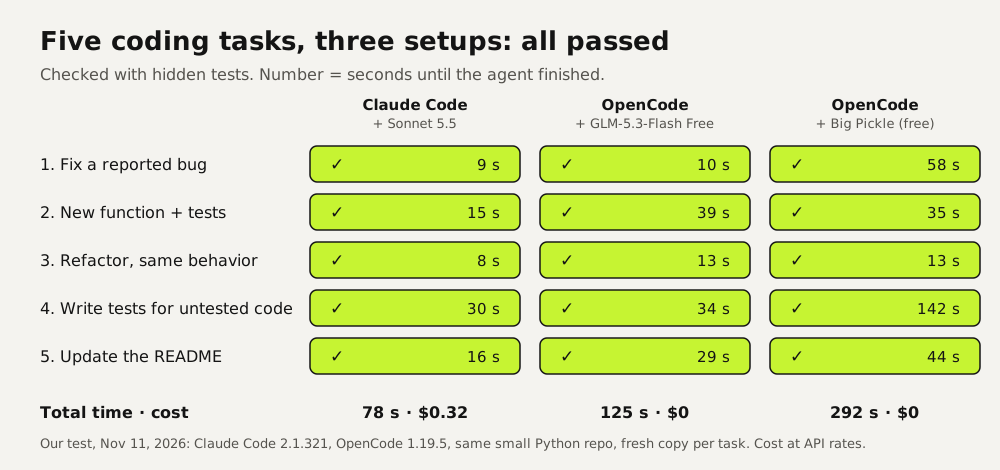
Pick Claude Code if you want the fastest, most consistent agent and already pay for Claude. Pick OpenCode if you want an open-source agent and the freedom to choose any model, including free ones. On our five-task test on November 11, 2026, all three setups passed every hidden check: Claude Code with Sonnet 5.5, and OpenCode with two free models. Claude Code finished in 78 seconds for $0.32 at API rates. OpenCode took 125 and 292 seconds and cost nothing. The bigger difference is where your code goes: one of the two free models may use your data to improve itself.
Tested by us on 11 November 2026.
The core difference: the agent versus the model
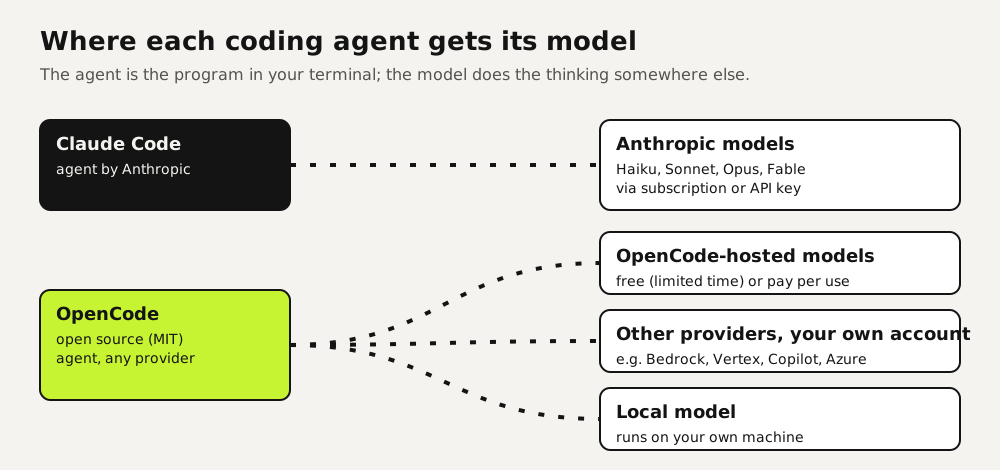
A coding agent has two parts. The agent is the program in your terminal that reads files, edits code and runs commands. The model is the AI that decides what to do. Claude Code is Anthropic's agent and talks to Anthropic models only. OpenCode is an open-source agent under the MIT license that talks to whichever provider you connect: models hosted by OpenCode itself, your accounts at cloud providers, or a model running on your own machine through Ollama or LM Studio.
How we tested
We built a small Python invoicing package with two existing test files and gave each setup the same five tasks, each from a fresh copy of the same commit. We ran the agents non-interactively: claude -p with Sonnet 5.5 on Claude Code 2.1.321, and opencode run on OpenCode 1.19.5 with two of its free models, GLM-5.3-Flash Free and Big Pickle. Afterwards we graded every result with checks the agents never saw.
| Task | What we asked | How we checked |
|---|---|---|
| 1. Bug fix | A customer reports $19.99 net producing 4.19 in VAT instead of 4.20 | Five hidden cases, including a half-cent that Python's round() gets wrong |
| 2. New feature | Add a statutory late-interest function, with tests | Five hidden cases, plus: did it write its own tests? |
| 3. Refactor | Rewrite totals with sum() and defaultdict, same behavior | Behavior checks on several invoices, and a scan for the old loops |
| 4. Write tests | Thorough tests for an untested module, without touching the code | Four planted bugs (mutants): how many do the new tests catch? |
| 5. Documentation | Explain reminders and VAT rates in the README, with a working example | Required facts present, and every Python example in the README runs |
Results: same quality, different speed and cost
| Claude Code + Sonnet 5.5 | OpenCode + GLM-5.3-Flash Free | OpenCode + Big Pickle | |
|---|---|---|---|
| Tasks passed | 5 of 5 | 5 of 5 | 5 of 5 |
| Planted bugs caught by its tests (task 4) | 4 of 4 | 4 of 4 | 4 of 4 |
| Total time | 78 seconds | 125 seconds | 292 seconds |
| Slowest task | 30 s (writing tests) | 39 s (new feature) | 142 s (writing tests) |
| Cost for all five | $0.32 at API rates | $0 (free for a limited time) | $0 (free for a limited time) |
| Data used for training | Depends on your Anthropic plan and settings | No, per OpenCode's docs | May be, during the free period |
On small, well-defined tasks, a free model inside OpenCode matched Claude Code on correctness. Claude Code was faster on every task and the most predictable. Pick the free route only for code you're comfortable sharing under that model's terms.
The diffs differed in style more than in quality. For the bug, Claude Code and GLM each changed the one rounding line; Big Pickle also edited a second file and added a test. For the README, all three wrote 45 to 53 lines and every example ran. Claude Code was the only one to finish the test-writing task in under a minute with that many tests: it added 28 test functions against Big Pickle's 20.
The free models: what they cost and what they keep
OpenCode lists several models as free for a limited time, and you can use them without an account. We did, in a fresh install. OpenCode's docs are specific about data. GLM-5.3-Flash Free's provider follows a zero-retention policy and doesn't train on your data. For Big Pickle, a stealth model, the docs say collected data may be used to improve the model during its free period. Other free models have their own terms, so check the list before you point one at client code.
If you want OpenCode with stable access, OpenCode Go costs $10 a month, Go Plus $40, and Go Teams $20 per member, according to its docs on November 11, 2026. You can also connect your own accounts at cloud providers and pay them directly.
What Claude Code costs
Claude Code is included in every paid Claude plan, starting with Pro at $20 a month, and shares your plan's usage limits. On API billing, Anthropic's cost docs report an average of about $13 per developer per active day across enterprise deployments, with 90% of users under $30 a day. Our five tasks came to $0.32 with Sonnet 5.5. Our Claude pricing guide breaks down every plan, and the model comparison shows what Sonnet, Opus and Haiku cost per task.
Which one we'd choose, and when
- Claude Code if you already pay for Claude, want the fastest turnaround, and value features built around one model family, such as hooks, subagents and the permission settings we test in our Claude Code changelog.
- OpenCode with a free model for side projects, learning, or code you'd happily publish, as long as the model's data terms suit you.
- OpenCode with your own provider account if you want one agent across several model vendors, or need a local model for code that may not leave your machine.
We work with Claude Code every day alongside other coding agents. What we noticed in this test matches daily use: on small, clear tasks the model matters less than people think, and speed and predictability decide which agent we reach for. On long, messy jobs that span many files, five short tasks don't settle the question, and we'll extend this test.
We have no paid relationship with OpenCode or Anthropic and use no affiliate links. We'll rerun this test when either tool ships a major release.
Questions
Is OpenCode as good as Claude Code?
On our five tasks, yes for correctness: OpenCode with two free models passed every hidden check, as Claude Code did. Claude Code was faster on every task.
Is OpenCode free?
The agent is open source under the MIT license. Several models are free inside OpenCode for a limited time; paid access starts with OpenCode Go at $10 a month, or you connect your own provider account.
Does OpenCode use my code for training?
It depends on the model. OpenCode's docs say GLM-5.3-Flash Free doesn't train on your data, while Big Pickle may use collected data to improve the model during its free period.
Can OpenCode use Claude models?
OpenCode connects to many providers, and some of them host Claude models. Check the provider list in OpenCode's docs for current options and terms; we didn't test that route.
Sources
- OpenCode docs: Models (free models and privacy) checked on
- OpenCode docs: OpenCode Go plans checked on
- OpenCode docs: Providers (including Ollama and LM Studio) checked on
- OpenCode on GitHub (MIT license) checked on
- Claude Code docs: Overview checked on
- Claude Code docs: Manage costs effectively checked on
- Claude: Plans & pricing checked on
More in pricing and comparisons
- Claude pricing: what every plan costs and what you getClaude Free, Pro, Max, Ultra, Team and Enterprise prices from the official page, what changed in 2026, and three questions to pick a plan.
- Claude Sonnet vs Opus: what we found running the same eight tasksWe gave Haiku 5.5, Sonnet 5.5, Opus 5.5 and Fable 5.2 the same eight checkable tasks. Accuracy, cost per task and where each model fits.
- Claude Code changelog explained: what changed November 2-10, 2026The Claude Code changelog for November 2-10, 2026 in plain English: what to use, what might break, and what we tested. Latest version: 2.1.322.
- Claude Code pricing: plans, limits and what one task costsClaude Code plans from $20 a month, plus our test: a coding task averaged $0.28 on Opus 5.5 and $0.09 on Sonnet 5.5. When the API is cheaper.
Also useful
- AGENTS.md Explained: One Instruction File for Codex, Claude Code and Other AgentsAGENTS.md is the shared instruction file for coding agents. How Codex reads it, when Claude Code does, and the one-line fix we tested.
- How to Build an MCP Server: A Tested Python and Node ExampleBuild a working MCP server in Python or Node, test it without a model, inspect it, then connect it to an AI app. Full code and the errors we hit.
- Building n8n workflows with Claude Code: what works and what you still checkClaude Code built, validated and tested three n8n workflows through n8n's MCP server. What worked, what you still check yourself, and the prompt to copy.